Pine nuts are expensive. You just can’t grab a handful to chow down without thinking there goes five dollars. I know they are saved for sprinkling on salads or making pesto. There they sit on the same shelf as the butter in a clear plastic snap tray like contraption. I see the price sticker on it clearly displayed. Frankly, I want a popcorn sized bowl of those rich oily smooth textured nuts. I want to roast them and eat them like peanuts while watching Ancient Aliens. Now we’re talking. Yet I realize I am forbidden from doing this. Never mind Ancient Aliens. I would need a second job to pay off my pine nut obsession. It has passed the macadamia nut level.
When I first started growing nut trees, I immediately began my pine nut quest. I wanted to solve that problem quickly. I grew many species over the course of three decades. Pine seeds are readily available as species from seed companies as well as within the confines of the arboretums who had mini-pinetums within them. One of my sources was Dean Swift Seed Company where you could order fresh out of the cone pine nuts, Pinus edulis, from as far north as Colorado. If you come to my farm today, you may ask where are your pine nut trees? You don’t see the trees or the carnage. The answer was simple. The alpine environment is not in southern Michigan. It is not the same ecology as the mountain ranges of Afghanistan, Italy or the arboreal regions of Siberia where many nut pines exist in the wild. This is the same reason you see Douglas fir trees fail barely getting to fruiting size. It is too humid here in southern Michigan in both soil and atmosphere. How many thousands of pinyon pines have to die before I give up trying to create a pine nut forest? The answer was over ten thousand. I did get one to flower though before finally saying farewell. It made a cone with no nuts. Even direct seeding into an area of my farm into pure sand did not work. That is not alpine. That was fake alpine. They knew. It only took three years.

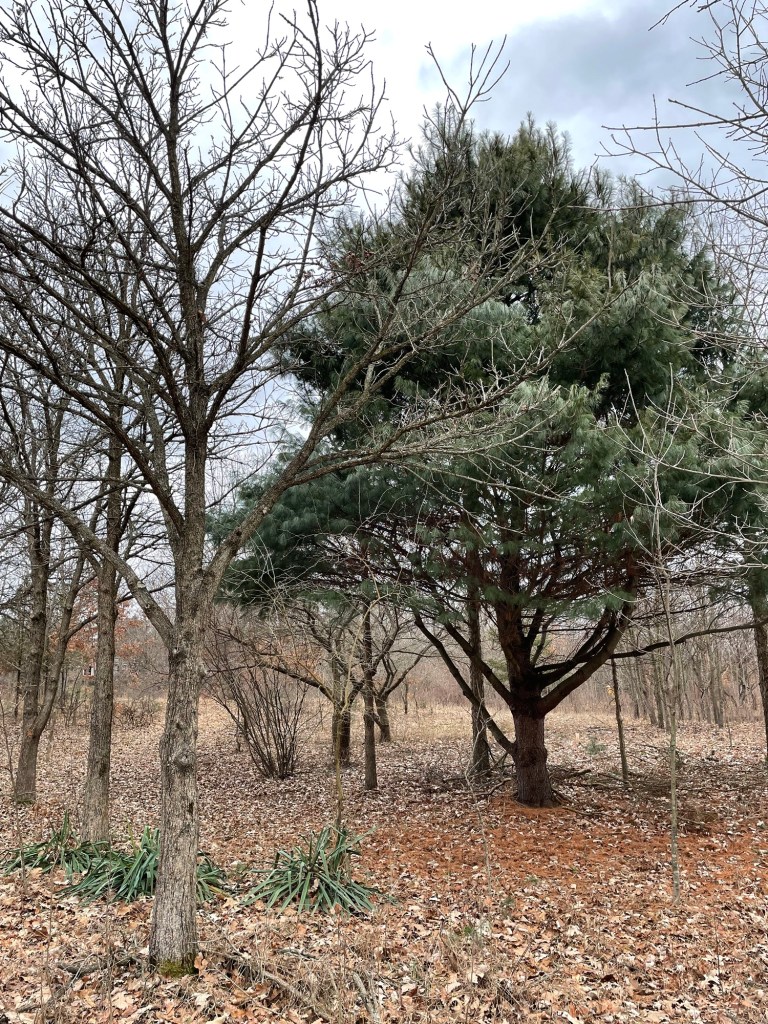
Today I have numerous mature Korean pine trees scattered around my farm. This has become my pine nut forest. This tree is adapted to Michigan and produces pine nuts. I have several surrounding my barn too. Many are just starting to flower and fruit after twenty five years. I have several in my outback area where I limbed them upwards and wait for the cones to form. Some of my seedlings came from the legendary Grant Mudge planting in northern Michigan. This was the largest planting of Korean pine nuts in the United States for a while. It was a small row of trees on a bluff overlooking Lake Michigan. It takes about two years to sprout the seeds. A lot of other things love pine nuts too and you have to protect them in screened propagation trays as you await their sprouting.

What I find interesting in the breeding and selection of pine nuts are the hybrids of white pine, Pinus strobus. The Himalayan white pine, Pinus griffithi is only marginally hardy here yet despite its propensity to disease and winter burn on the needles I did find a few seedling types that show promise as a nut pine. It appears the hybrids produce large amounts of cones. They hybridize with the white pine and potentially could cross with the Korean pine nut. This could help in creating a diverse progeny to make selections from as well as create a population of fruitful and highly productive orchard type trees all with thin shells. One in particular from Germany has huge crops of cones some of which are almost a foot long. I collected a couple of bushels last year and ran them in my seed processor thinking they were rich in progeny and genetic variation. Unfortunately, all the seeds were blanks. If you look under the parent tree, you do see some seedlings popping up here and there. I am moving some of these closer to the Korean nut pines in an attempt to set cones of a hybrid origin. Its a dream I will keep alive but only because I love pine nuts and nothing else.
It would take a little breeding or selection but it could be done. It turns out that others have found the Korean pine nut easily cultivated but the shells are quite thick. There are some varieties with thinner shells as well as larger seeds too. This might not matter in terms of cracking and processing technology but if you combine it with a high yielding cone as well as a larger seed then it is possible to move that forward much faster. It would be the pistachio of nut pines in many ways with a paper thin shell of Pinus edulis but the ability to grow in a variety of climates outside of the world of mountains and minus fifty on the fringe of the artic world of permafrost.
I kind of get the feeling that pine nuts need to be employed at a large scale to make it worthwhile. You need abandoned land that even jack pine has worn out its welcome. You need quantities of seedlings produced from its native Korean range. Having a means to establish the trees and monitor their growth would be helpful. A thousand acres would be enough. This would create a repository large enough to judge the nut pine as a nut producer in the world dominated by jack and red pine. It would be tough to get your foot in the door but it is possible. A pine forest is not something new. Those the world has known for hundreds of years. A pine nut forest is something new. It would be a calorie full rich forest filled with delicious goodness. That is a forest we would all want to live in. I would move there if I could. There I would eat bowls of pine nuts and watch Ancient Mysteries of the Unknown Aliens while snacking my way to pine nut nirvana.


Schwerin Pine Pinus strobus x wallichiana The origin of this pine traces back to the estate of Dr. Graf von Schwerin in 1905 just outside of Berlin. He was a resistance fighter against the Nazis in Germany. He was put to death after implications of his involvement to assassinate Hitler. The pine discovery was a seedling found in his garden as an accidental cross of the Himalayan white pine and the Eastern white pine. I was fortunate to get seed of the original tree and have only one tree of it today. I have grown many other white pines from Mexico, southwestern U.S., Austria and unknown seedlings here in Michigan. Some of these have done very well here but cone production is low so far.
Schwerin pine is a cross with the Himalayan white and the North American white pine usually produced by grafting. It will back cross with other five needled white pines but no one knows the extent of this. The tree is fertile and does produce some seedlings but most of the seeds are blanks. Last year I collected a couple bushels of cones only to find there appear to no viable seeds in the lot. I am not throwing out the seeds because it appears there is a one percent chance of fertile seed in the lot. One seedling I grew made it to four feet in three years despite being hammered on by deer. That is a good sign for hybrid vigor as well as fruiting at a young age. The Schwerin pine would be a good bridge for producing this nut pine with thin shells and heavy production. One seed is enough. I will move some of these hybrids near my mature Korean nut pines in an attempt to naturally cross them.


 biologicalenrichment
You must be logged in to post a comment.