
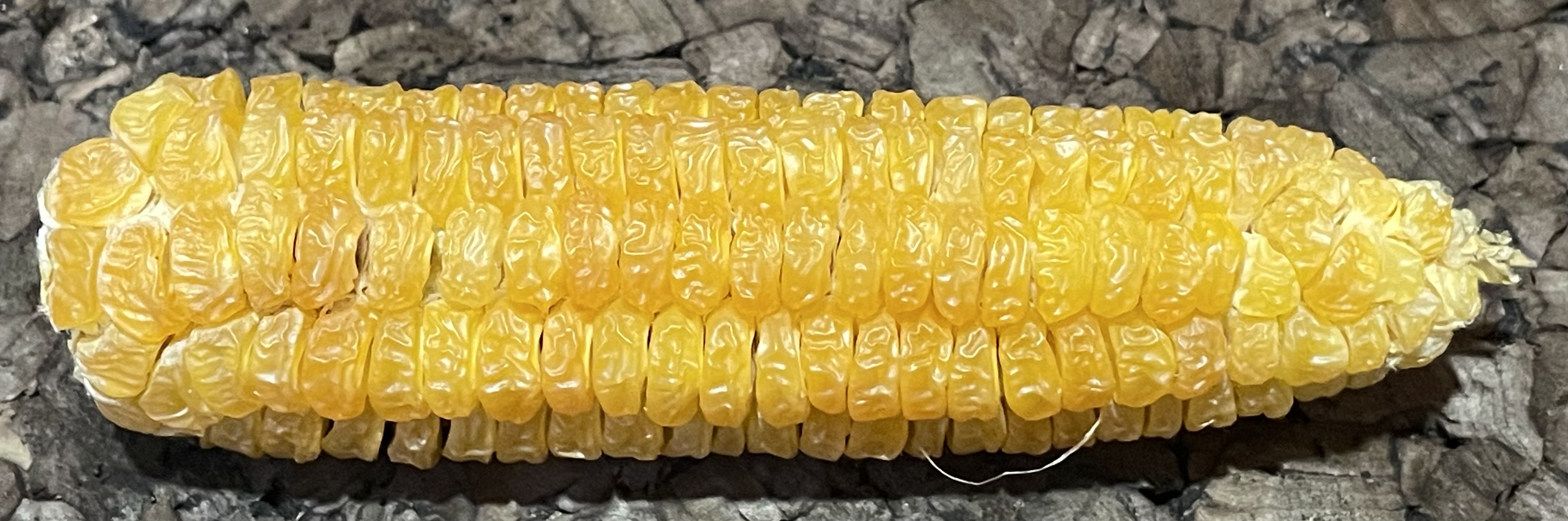
Extreme environmental changes will require a major shift on how and where we grow certain human edible crop plants. Although human edible corn makes up less than five percent of all corn, it is still important to think of it as an ally of nutrition, healthy and even a solution to climate change all wrapped up in one. The Ashworth sweet corn pictured above highlights this idea of a short season crop that requires less resources to grow while ripening its crop around 60 days. Despite its smaller size, it is a selection that could be used as a secondary crop for many applications. I purchased it on Ebay. All power to Ebay, the home of things you can’t find elsewhere. I heard about this corn from reading about the late Fred Ashworth, the founder of St. Lawrence Nursery. When I grew it out, I reselected it for both pure yellow and bicolor kernels while keeping the short season part of its heritage. It was very stunted when I first did it in the polyhouse years ago filling up one 30 gallon grow bag of soil and then moving it outdoors for a while and then back to the polyhouse to ripen free of racoons. I called it my traveling sweet corn.
Sweet corn could be used in beginning tree crop plantings as multiple use scenarios before the crops begin bearing. I view it as a nutrient collector able to create healthy food in a short season area. This is a type of integration of a well known annual crop able to meet these demands in the rough and tumble world of heat, drought and fluctuating temperatures. Although the yields of Ashworth sweet corn are very low compared to Peaches and Cream, it can be used as a green manure too building up precious organic matter at the same time. The philosophy, “Its not broken, why fix it” pertains to annual crops being implemented in mixed plantings. But certainly it could play a role in our re-creation of our tree crop and orchard systems. A few have ventured into the pollinator friendly native plants. But commercially that idea interferes in many ways with current orchard practices and it costs too much to implement with “no crop sold” in the end other than the environmental benefits which is good but not good enough. It would be better to combine the ideas to make a secondary crop even if it is just a seed crop of some type. The farmer needs to be paid for his ability to role out new ideas right away from the crops he is tending both perennial crops and annual crops.
This was the reason for my fascination for short season crops. At the same time, the annual crops seed production could be developed as seed production saving time and resources. So in some ways you end up with a population of plants being selected for this localized ecological conditions.
I once met a plant breeder who worked in short season crops in northern Canada. The goal of his work was to develop short season crops including sunflower, soybean and corn. He was to create other crops outside of the major canola industry for use as oil or animal feed crops all ripening in under 60 days. In fact some of them were 30 day crops. What happened to his crops? They were shelved and never used. This highlights the importance of developing connections to the farming industry with your new crop and joining forces with others who want to make changes on a broader scale. Just because you breed something, doesn’t mean it will be used. I got a feeling there are a lot of shelved crops. To solve a crisis we need all ideas on deck otherwise it will be too little too late.


 biologicalenrichment
You must be logged in to post a comment.