
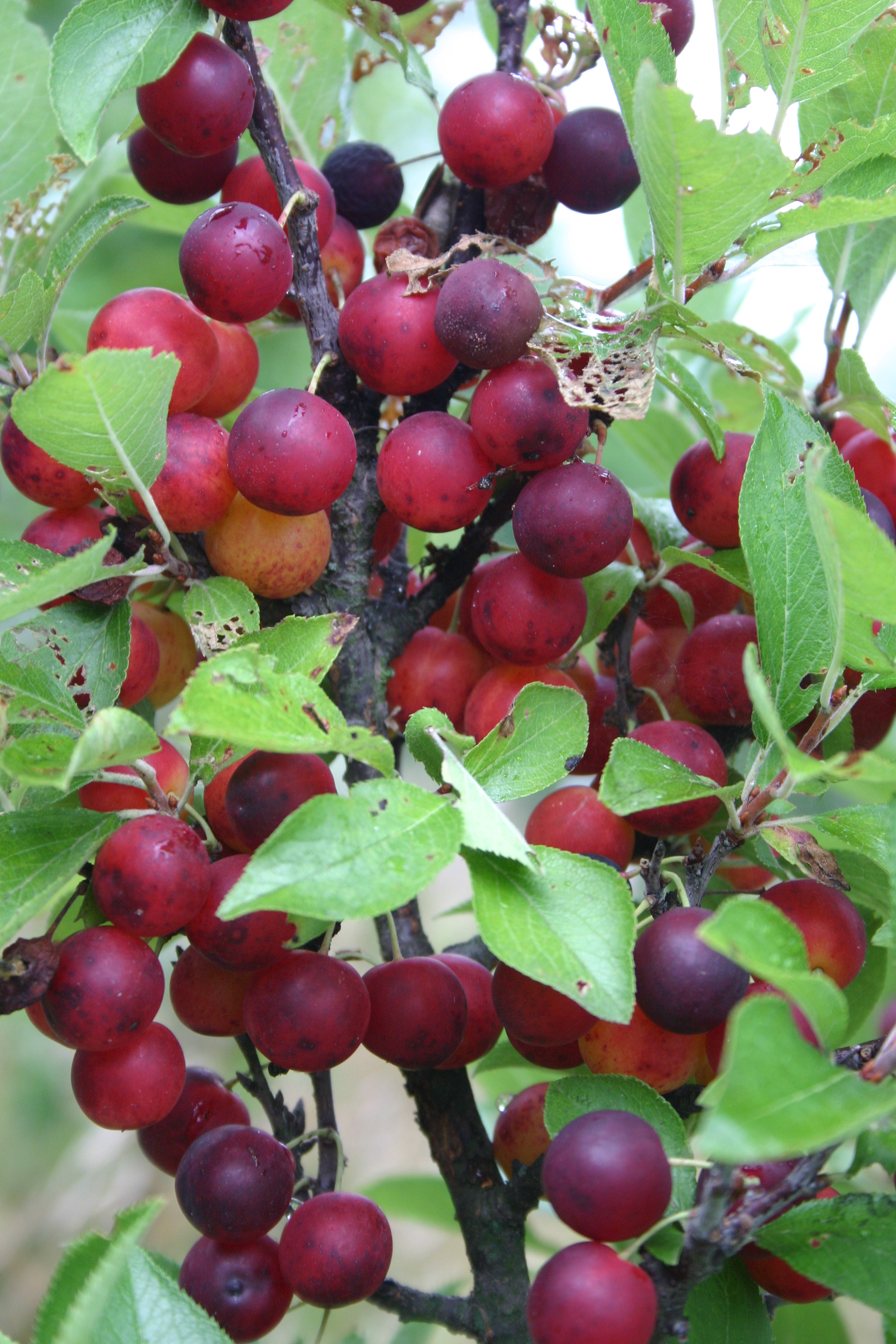
There has never been a greater example of a species of fruit that could be grown as a species of fruit without employing the cultivar based system of fruit growing. The above image is one of the first beach plum seedlings grown in my open field using prolific fruiters selected from populations I was growing for the mail order-internet nursery trade. I noticed it was quite common in beach plums to see flowering on young one and two year old plants. I would tag these plants and carry them to one of my hillsides and plant them in small groups. This was a success. The pasture was thick with grass still and I would use a cellulose mulch mat and the black polyethelyne types. The plants grew very nicely in these locations. I would add a layer of sawdust as mulch after the plants got established as I removed the mats. As time went on and I grew successive generations from these plants from seed, they too were very productive and had a more compact nature to them which came through in the progeny. Now called ‘Nana” it was my first seed source of the beach plum, Prunus maritima. I sent seeds around the world to share in my discovery at the time.
What did not work so well was my employment of an idea of using seedlings in commercial fruit production. This would be considered too far outside the mainstream fruit industry. Certainly it was a rousing success in my retail trade in peoples backyards with a few plants or rows of them here and there. It was without a doubt one of the most celebrated fruits for jam production and fresh eating by homeowners across many zones of growing. Everyone had very good success. They flower late. They resist insects and diseases and they are super productive. Until recently it never got to the point where someone put in several acres of my seed selections. Certainly it was a good idea but who is going to risk that. The answer is a few pioneers of an industry have come forward and are now doing exactly that in quiet solitude.
This idea of commercializing a fruit species is a good idea but it costs a lot of time and effort to establish any orchard. If it is seedlings, then it adds a large amount of both confusion and doubt in the blender of information led by the cultivar only industries and pretty much any commercially acceptible practice. “No one plants seedlings Ken.” I can still hear it. My response was to plant more seedlings. Lets test this weak theory of cultivar evaluation and find a way to overcome our bias was my action to counterbalance this philosophy. To calm everyone down, I also named several selections at my farm to help them in generating their own seedling plantings. So I am not adverse to cultivars. It just at some point, it is not necessary and at others it is a complete waste of time.
First you have to identify the problem. The graft unions of beach plums are short lived. Eventually they break down and just snap off. You would have to replace the shrubs in less than 10 years. This would be super expensive to do. No fruit farmer I know has that sort of cash lying around at the end of a cycle of an orchard. Peaches can be short lived too but at least you might have some profitable years in there to pay for the new orchard. Beach plums have an unknown value commercially because they are currently wild collected. There is no farmer. So possibly this is the way to go first. Plant them in public areas-locations in poor soil, uncared for on state land on denuded hillsides and open fields with little vegetation. There are rocks. There is sand. There are birds and things. You see, I’ve been to the desert on a horse with no name……Wait, is that a song? There is hot sun. The soil is acidic in nature. The growing climate is short and unpredictable. The frosts are late. Now we are talking brofessors. This is ideal for the beach plum. That is the future of the beach plum. It would be a plum on a beach in an open field on a denuded hillside free of fruit farmers who have to work very hard for very little money. It would reproduce and spread on its own creating a future crop for a future generation. This is the future’s here right now moment of the beach plum in “Farmerless Fields.” I am heading there now. Follow me if you would like.


 biologicalenrichment
You must be logged in to post a comment.