
Like my family’s Christmas tree farms of yesteryear, most tree crops are planted in long rows of a single species to maximize production. At my 13 acre farm, I did not have the luxury of both time and money to create some sort of commercial operation of any magnitude. I did think about it but as time went on I realized this was not a good idea. For a while I purchased grafted trees. Almost all of them are long gone now. It was an expensive experiment and luckily I only tried it periodically if I had to. Except for the outer rows of seedling American persimmons, oaks and northern pecans, plants at my farm are not in rows. They are more like clumps and reflect my ability to do this when I was younger while raising a family and squeaking out a living from my nursery. This positively improved my design habits and ability to maximize space while at the same time select woody plants from around the globe to be part of my planting in some way. I did a Buckminister Fuller tetrahedron type of design with triangle based diagonal plantings depending on the location of the plants. As time went on and new plants were added or replaced along with new plants seeding in, I kept it organized in a way that allowed for a person to walk under the trees while the crown changed the vegetation changed at the forest floor level. It was a multi-story agriculture I was creating from the ground up.
For some time, I held on to a dream that I would buy another 400 acres like our family’s farm previous Christmas tree farm in central Michigan. It was profitable at the time but involved much more management than my postmaster father and partner could give. But it was inspiring. Even today I search the land and farm sites to dream of a giant tree farm of infinite diversity. Its good to dream of a field with no trees with open space all around. It’s a funny dream but I can’t stop thinking about it for now. I often wonder if younger people can buy land and do what I did in some shape or form. I met a few of them on Instagram and some are well financed and naturally have careers in other non farming industries. Others are like me and flying by the seat of their pants. It is fascinating in that there is a certain group of people who just love to plant trees. On a side note, it is not just native or non-native. It is just trees, any tree. It brings happiness. You can see your progress over time and is one of the few things you can do to that by and large taps you into the laws of nature on a more fundamental level. So it does not matter the scale, just the intention and the love of doing something connected in some way to family, friends, community and nature.
Having a small tree farm is additionally beneficial in that it is possible to create a repository based on your interests with minimal investments of time and money. From seed is likely the best method for this type of planting. I attended many horticultural shows when I was younger and learned how orchard systems were designed. I worked for a few fruit farms and nurseries prior to my own nursery. Your interests will change over time and likely you will look back and ask yourself, “what was I thinking” in terms of your ideas. On a tour of my farm recently, I had someone ask is there something I felt sorry about planting or something I planted that I wish I didn’t. The answer was no. Nothing. I cannot think of any plant anywhere on my farm that I am disappointed, disturbed or sorry about. Even the plants that seed in that are thought of as weeds are actually quite good in terms of their effects on my farm. I definitely am not sorry. After that question, I began to think is there anything I am sorry about in this relationship I have fostered with nature. No. It’s the opposite. When we walked by an area I planted with canary reed grass and Miscanthus you could see this persons face drop ten stories. I don’t think I answered his question fully. Did he realize that all the history of agriculture involves distribution of plants by humans uncontrolled by governments and institutions? No. He owned a seed company. That was the lense upon which he saw the world. Everything is controlled now. Yet at its basis all seeds were and still are for the most part handed off from one person to the next. You can see these seed exchanges growing in great numbers every year. It’s a power that says something about the strength of the individual and the importance of seed keeping and organizations like Seed Savers Exchange. Lets hope that doesn’t get watered down over time. People love to control things in terms of their interests and how they see the world. I also hope that people don’t abuse those systems and think ‘free seeds’ and squander an opportunity. I have seen that as well.
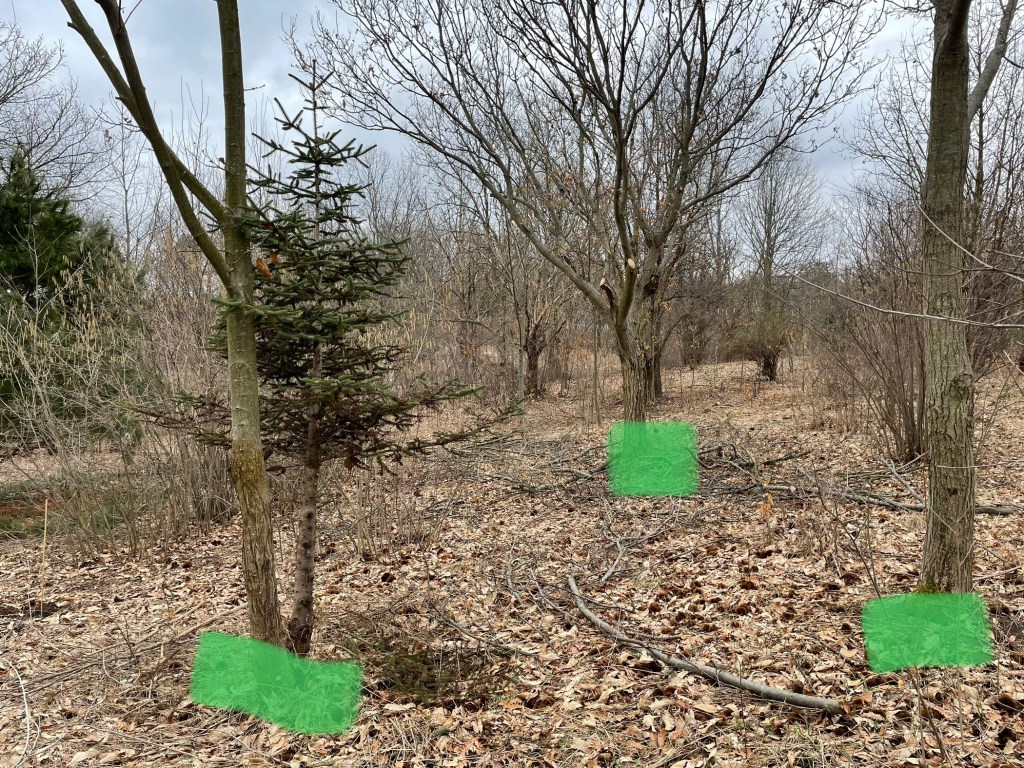
The above image shows a form of regeneration at my farm which helps the trees stabilize and overcome a disease. In this case, hybrid American and Korean chestnuts that are allowed to seed into the hybrid hazels and a lone Abies religiosa fir tree. It started by the tree in the background as the parent tree. I tried to plant other chestnuts in this group but they all died after ten years because of the blight. I chose poorly. New seedlings came in from chipmunks or deer planted nuts with them stepping on them in the leaf and grass mulch which is never mowed. Nature chose wisely. These trees are highly resistant and immune to blight. Their strong growth and heavy production of nuts says something powerful about new generations of trees direct seeded from a parent tree that has overcome obstacles. Each of the green lines show only a portion of the story of regeneration. This is found 360 degrees all around a tree that was selected from the original Douglas hybrid trees in upstate New York that flowered and fruited heavy when 3 years old in my seedling plantings. It contained vigor, good branching and heavy yields of small nuts. Over time new trees are crossed nearby with the Korean chestnuts that I selected from seeds from the late Norm Higgins. I purchased all of these seed nuts from growers who also understood the value of seedling orchards. At that time, there were few if any cultivar chestnuts available. They too understood the value of resource management on a small scale because grafting was both impractical and not particularly successful at the time of creating an actual real orchard system of genetical indentical chestnut individuals.
Maybe you don’t want a genetically identical planting with identical plants of identical parentage with identical characteristics. Maybe that is not your heaven. If it is not, then certainly don’t feel sorry.
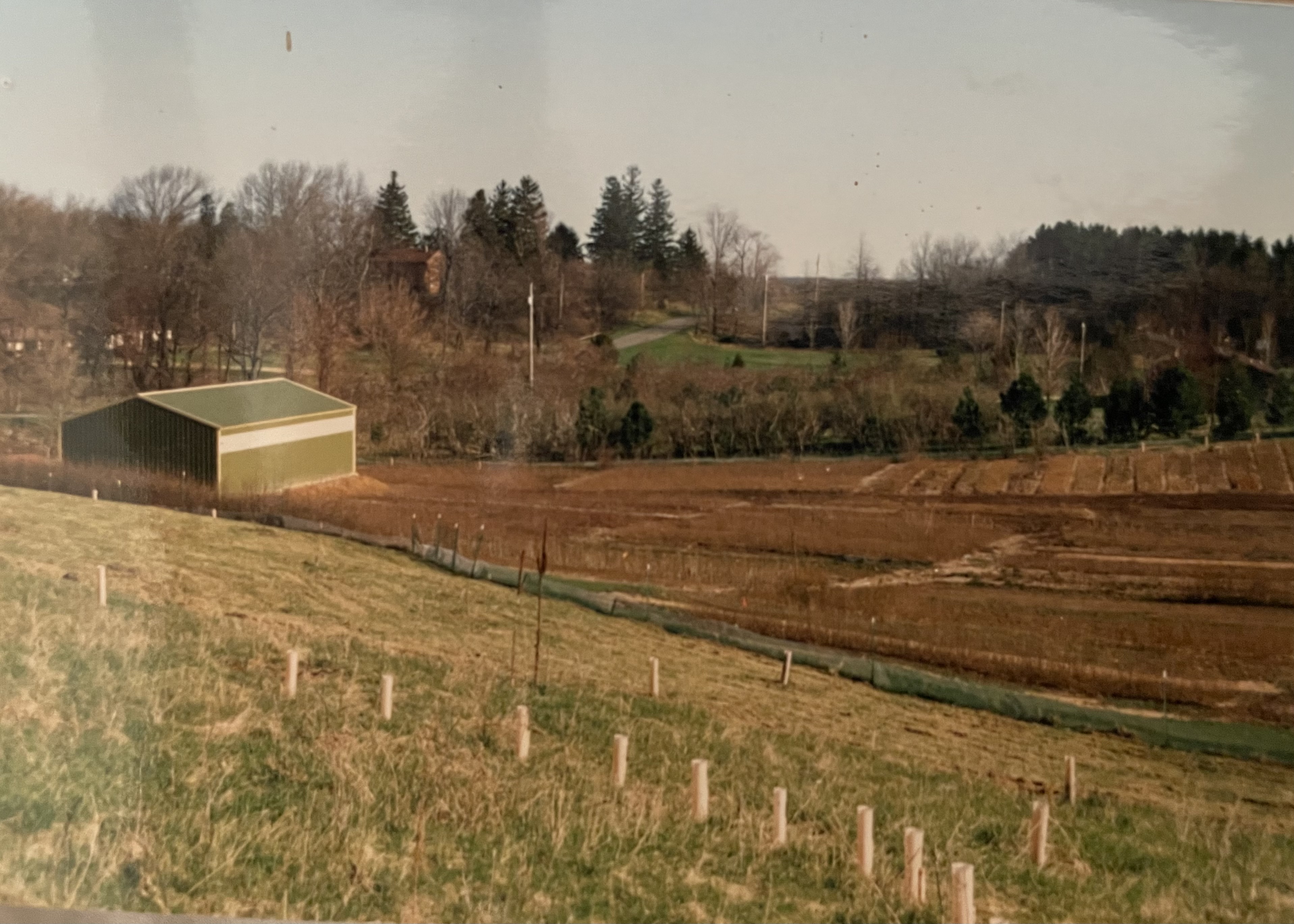
The farmerless fields continue.


 biologicalenrichment
You must be logged in to post a comment.