
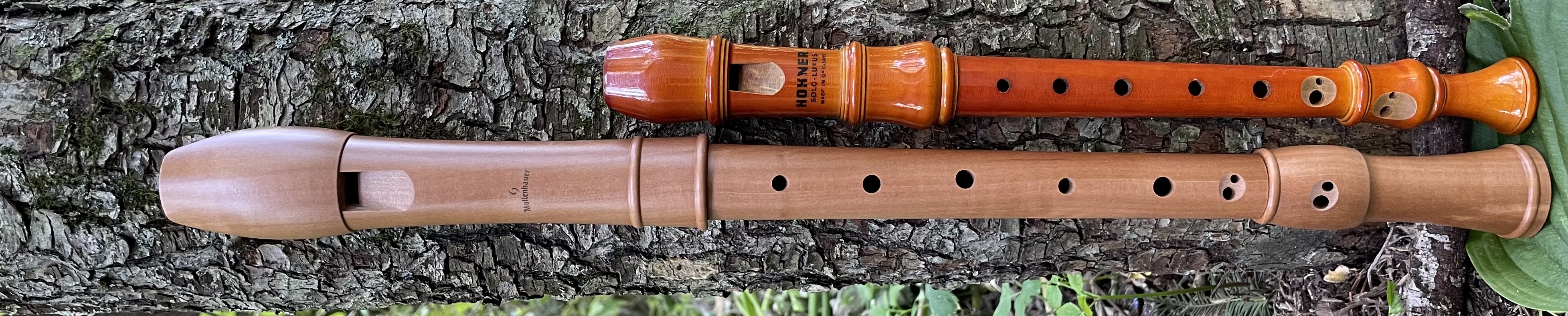
I own two soprano recorders that are made out of fruit wood. One is apricot and the other is pear wood. The pear wood recorder is a Hohner that I purchased when I was in high school. I brought it in to my physics class to see its effect on an oscilloscope. My teacher, Mr. Stoner loved it and he soon purchased one and used it in future classes. I would take my pear wood recorder with me when I went camping and played it in the woods or at my farm in the deep swamps. I just loved the sound of it in nature especially if it was windy. I recently purchased an alto recorder also made from pear wood. I haven’t practiced this too much yet but it has a very subtle smooth tone. Pear wood has a nice clear projection and I was wondering if you could make a guitar from it. That got me thinking of its possibilities in the specialty wood musical wood markets most of which is filled with tropical woods.
The pear wood idea stuck with me over the years. I could not shake it. At one point a wood worker who was picking up trees from the nursery told me about his use of pear wood for organ cabinents. He said it was a fantastic wood to work with. Once in a while he would spot an old tree in a backyard somewhere and ask the owners if he could take it down. He would pay them for it. Then he would have it milled for his cabinetry work. Often they were hollow and not usuable but every now and then he would find a good one solid and clean of branches for a few feet. This type was becoming more rare with time as pear trees often become hollow with age. Pear wood is a hard and dense wood and has traditionally been used for recorders and violins. In tests done in a lab pear wood had excellent sustain. This specialty wood is hard to come by in the United States so it is imported as Pyrus communis or the European pear. It is often listed as Swiss pear. When that cabinet maker arrived at my farm I was in the midst of cleaning up some of my old plantings of hybrid pear seedlings. Decades earlier I had created an orchard using seedlings from an old tree found in Michigan imported by a USDA scientist who planted it at his home. He spent a lot of time in Pakistan. Those particular seedlings produced seed for me and allowed me to create a pear population of mixed genetic heritage. That of course I love. I began to think of using these seedling plantings as a means to select faster growing and straighter trees for wood production the same way you would use black walnut or black locust. It would make it possible to harness this powerhouse of a plant using selected seedlings that grow faster and straighter than what we know as the average pear. That actually worked. I used a few types to do this. I found a couple trees near an off ramp of I-94. Foliar diseases and fireblight were rough on those but I did manage to keep a half dozen trees in the planting. One of the first plantings I focused on using the crosses that were dominant as the Asian pears. Most people know these as the Giant Korean pears. The difference were these were much smaller in fruit size. A few were absolutely spectacular in growth. But like the European highway pears, only a small portion were usable for seed production to any degree. Finally I had two plantings where I used a broader scope of seedlings of crosses with the European, Asian and Callery pear which led to much more success in terms of finding a population of healthy trees that grew straight as arrows with few narrow crotch angles. Ornamental pears often have the narrow crotch angles. This is damaging to the tree under stress from wind, snow and ice. This would be a weak characteristic for the trees if you are growing them for wood and want clean straight trunks with no splitting. I was surprised it was not that hard to do. The hybrid pears do produce fruit but in general it is not usable to eat very much being small and quite astringent. Most of the trees energy goes into its growth. Black squirrels love to eat the seeds of them starting in July as they go from milk stage to solid seeds. They husk the green fruit to get to the seeds. You can hear them crawl around the tops of the trees as they leap from one tree to the next. I then started doing the same with apples. Those will require a lot more selection and already I have found timber forms within certain populations.

What value is this to woody crop agriculture or forestry ? If you look at those individual scientists and horticulturalists who have done similar types of projects in the past they almost all tank and have short lives. The ideas are very good and notable. The ideal selections were found and propagated. Whether the tree is larch, popular, black locust, honeylocust, chestnut or oak it does not matter. These species or selections are quickly relegated to experimental. You can create it. Yes! Black walnut made it to an extent. It just can’t be applied on a broad scale. Certainly you can do it on your own land with your own money and sweat equity like I did. Certainly you can educate and attempt to find ways into this brave new world as I do today. That of course is something I feel passionate about. It just is too time and money consuming to attempt side projects that require a land owner or farmer to accept the risk of planting any tree and hoping to harvest it in 25 to 50 years. No one thinks long term for a reason. It is not practical to employ. It sounds too far off in the distance. Will growing the trees be profitable by the end of the cycle. This is changing but very slow. I would put it on the scale of architecture. It takes time. In the meantime, there is nothing wrong with setting the stage, demonstrating the power of plants and showing the benefits to others who will take notice. There has to be a place where others can get ideas from. It can’t be locked away and forgotten. Put it front and center. Destroy ignorance with knowledge and tell others how you plan to harness this natural law for all good. This is the human side of it. That grows very slowly compared to the trees. But it is growing. Let’s just hope we have few storms along the way and our ideas produce fruit.

The farmerless fields are infinitely diverse.


 biologicalenrichment
You must be logged in to post a comment.