
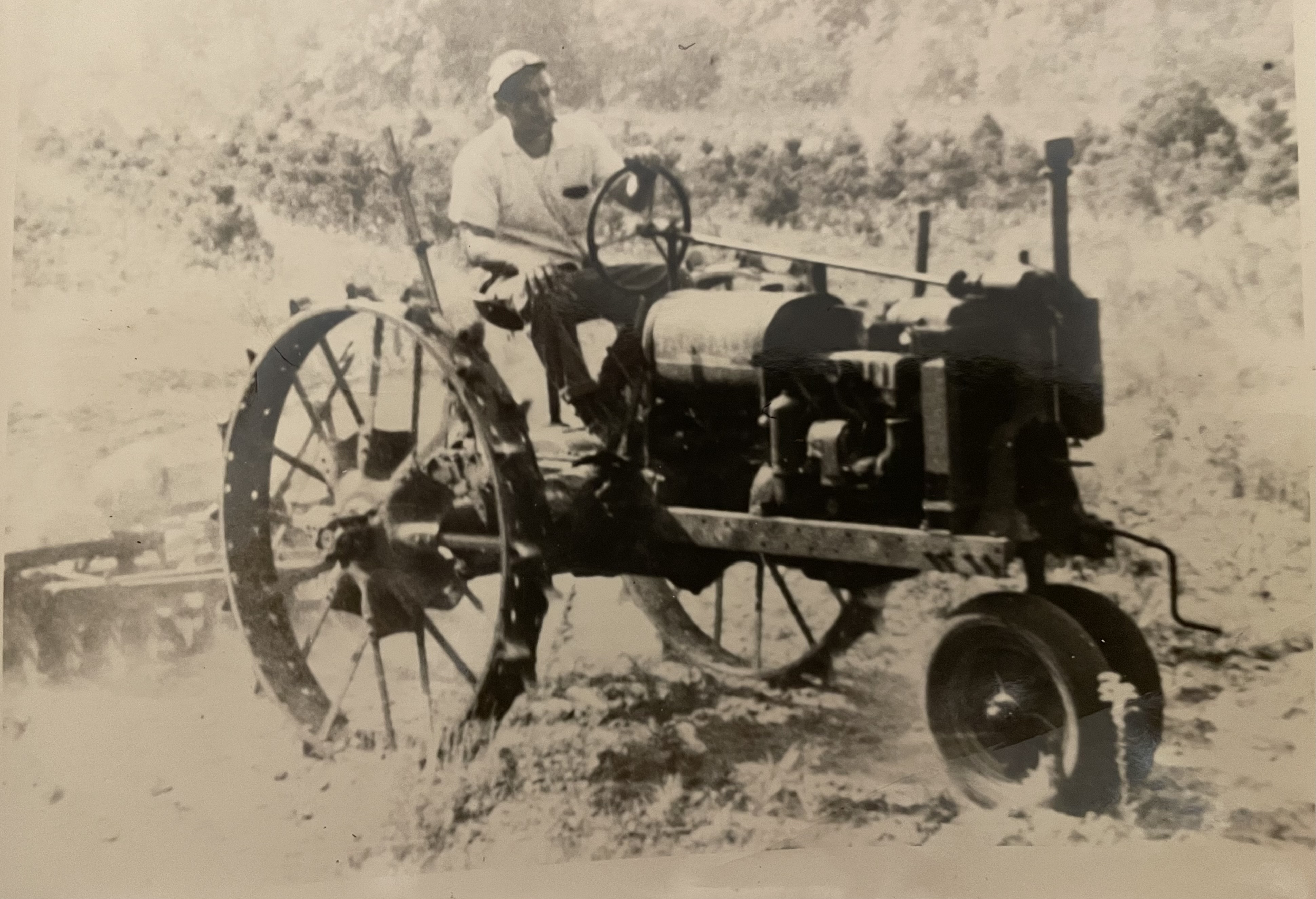
My father and his friend from the post office had this idea back in the sixties. It was not easy to get anyone to agree. Out of a dozen potential partners only one remained in the end. It was 140 acres of swamp with an extremely high water table. There was one hill and several sandy open areas. No one wanted it. This marginal land was ideal for Christmas trees. There are other crops that could have been attempted like blueberries but these types of fruit crops require a large financial investment beyond the postal salary range. You could buy a used tractor with metal spiked wheels along with the hand crank starter and you could afford seedling Christmas trees which were often sold for pennies grown by the state of Michigan in its forestry nurseries but not much else. You are raising a family. You just built a home. You go to church every Sunday and pray for help from above in the form of precipitation. You are kind of winging it in the branch of knowledge known as agriculture. You read, you study and you learn how to do something you are not familiar with. It was a bit of an unknown at the time. As a participant in the family tree farm, me and my siblings quickly learned about pruning and the maintenance of the farm. A barn was added by disassembling one in a nearby township, moved and reassembled with help from other postal employees. It was fueled a bit by beer, food and friendship with other postal employees. Everyone pitched in. I know that removing the barn took a lot of nail pulling one by one.

What made this tree crop successful at the time was low cost, ease of establishment, low maintenance and a strong existing market. You could also use marginal land where basically all crop plants would not work. The idea of creating new tree and fruit crops often is lost in the ability to replicate these plantings across many geographic zones with a crop that is in high demand with a good price. The cycle for Christmas trees was roughly 8-12 years depending on the species. Then you started over. There were periods where over planting sunk the market making it highly unprofitable. If you are trying to put up a new hazelnut or pecan planting you have to think in terms of a large expenditure of equipment and infrastructure to make that crop available. Unlike cut your own Christmas trees, you just can’t hand someone a saw and point them to the field where the good ones are. It is way more complicated. For this reason, the governments of other countries get involved and buys the equipment, storage facilities and helps the farmer bring the crop to the markets of their country and the world. The governments and industry leaders also lend a hand in cultivar development and employment to the farmers. It is a certain level of scale that one farmer helps another ad infinitum with one crop.
The idea is to make use of the land and allow future farmers to thrive and make money. Here in the United States we would not likely do this type of financing as far as I am aware which is why these other countries are leap frogging over us in terms of certain nut crops. There also is money to be made and some industries are proactive in getting their message to government leaders to support them. They need producers of the crop they sell. The USDA offers loans and grant money to fund new agroforestry crops. I am hoping this funding doesn’t limit the creativity of the farmer in some way binding him or her to contractural agreements or certain crops over others. The new varieties of hazelnuts are here. The northern pecans are long ago discovered and available yet there are few plantings. It will take a partnership of people, organizations and government to establish these crops in this land of corn and soybeans. It will take many species of tree and shrub crops to create a healthy human being. These will be perennial in nature pulling up the micronutrients deep within the earth. This is where we are headed.
Farmerless fields can hold our repositories of wild fruit and nut germplasm available to all. That we can do now.


 biologicalenrichment
You must be logged in to post a comment.