I always had this idea that the roadsides could provide food in terms of nuts and fruits along with a few perennial vegetables like sunchokes. It seemed like unused space with huge potential. All you would have to do is drive around and find trees laden with nuts and knock on a few doors. I used to do that. It was fun. I met a guy in the North America Fruit Explorers once who was trying to legislate the land along the interstates be made into a fruitopia park. There is a certain element of safety in all of this. Today the road environment is not ecologically friendly. There is a huge variety of chemicals being used regularly for vegetation control even in state parks. Mowing is critical to keep the shrubs down and anything that would be planted would likely get nailed by herbicide or mowed into a fluffy pile of cellulose chips. I see them busy on the interstate and the county roads. Herbicides are casually used everywhere so eating the wild in these locations is not good.
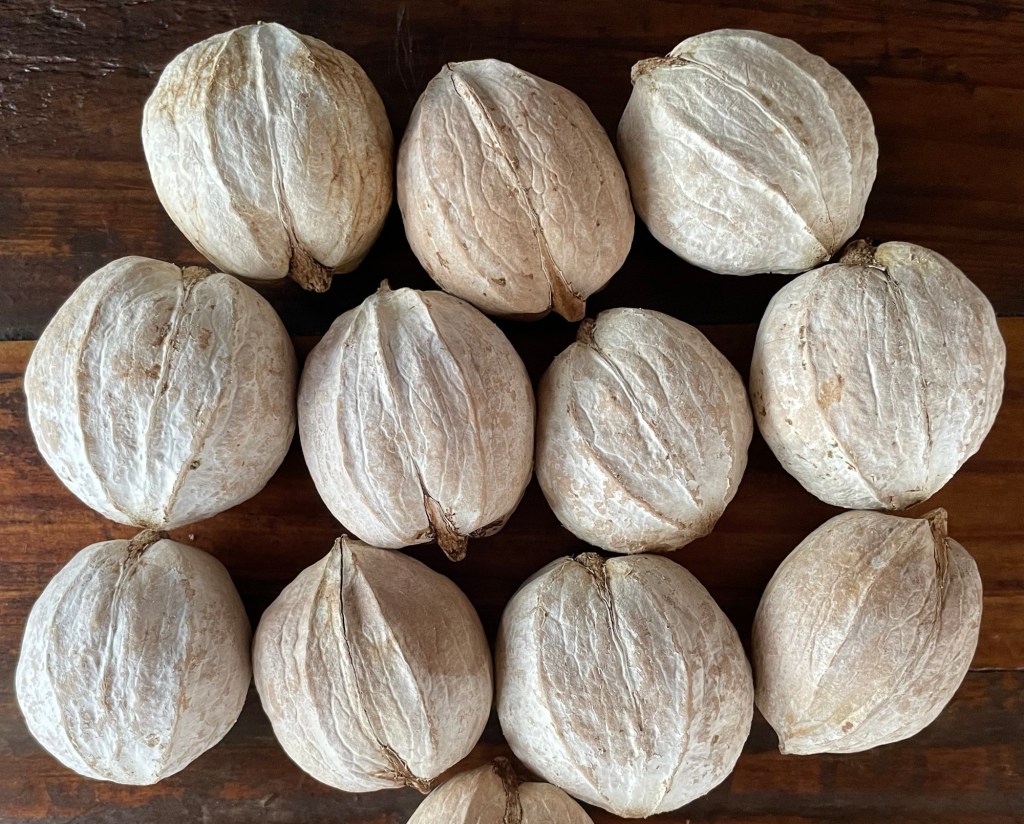
Once while running on a road in northeastern Kalamazoo county in southwestern Michigan I discovered a shellbark hickory. I had read about this plant in my botany classes but never saw a real one. I was excited and stopped at the door of the house to talk to the owner. He smiled and laughed as he too loved the nuts and would pick them up and crack them with a hammer. It was funny to him because people would stop a lot to get those giant hickory nuts. His house was close to the tree less than thirty feet away so he could hear people on his lawn. He would politely ask them to leave usually but not always. Once someone came at night to steal the nuts. It was one of those ‘you damn kids, stay off my lawn’ moments only it was mature adults as they scrambled back into their car. I was fortunate he owned that house for a long time and I collected once or twice there. It turned out that this tree was not common. Today if it was a seedling and just starting it would never survive the torture of herbicides.
As someone who understands herbicide use and its futility outside of modern agriculture, you have to wonder what type of vegetation we are creating in the future near our roads. You have to ask, “what is left standing?” It is kind of a nomads land of county and state owned roadsides that few people really look at. We all just drive by. Many of the plants people don’t want are even in greater abundance after spraying. It’s nature’s response to the damage we are doing. It starts by creating this excellent seed bed of crushed wood and leaf litter. I always felt like we are getting screwed. Just the physical appearance of it looks horrible. The idea of edible plants is long gone but larger trees are still there but fading over time. Even some power companies are herbicide nuts now and feel they too must nuke the landscape to create a non-woody environment. It doesn’t work for long but this is what they are told and then follow through.
So this year with a mental pad in hand, I began to take note of those plants which not only tolerate the damage to herbicide but seem to be thriving despite it. I got this idea from last years go round with my county road commission which basically destroyed a couple thousand dollars worth of groundcover, shrubs and small trees in my front yard. I take walks down the road and botanize along the way. I use to run and bicycle down the road but I found the distracted driver syndrome too high for my blood and now limit my pedestrian time. My knees are thanking me too. By the way, what is it with all the small Fireball Cinnamon Whiskey bottles? Maybe that is a bigger human problem than the vegetation.
I was a bit surprised that the leading environmental organizations promoted their use too. Some of my past employees worked for them in some capacity and they filled me in a little on the details. Here is what happens. This is a bit like the county road policies. People spray. They are on a mission. After the spray, they see things dying. Mission accomplished. They high five each other and leave. No one evaluates the non-target plants or potential damage to animals. No one cares about your lilacs or white cedar trees you just planted. Its brutal out there brothers and sisters.
As these policies continue on the roadsides large volumes of dead wood and standing dead shrubs blanket the forest floor. This slowly drops over time creating this beautiful seed bed. Unfortunately, all deciduous tree and shrub species seedlings cannot tolerate the herbicides so they die immediately. There is no up and coming trees to replace the older trees. In the meantime, annual plants and a few deep rooted perennial species survive. Again its a combo of cinnamon whiskey type of garbage, herbicide and salt in that soil. I think it is a miracle anything survives. You may not like it but it does not matter. More herbicide will not change the composition. If I can be a little dramatic, you are on a treadmill of death. We paid for it and now are proud owners of this new flora along our roads due to our ignorance of herbicides and their effects. Here is the line up. Imagine intentially creating a landscape out these plants. Oh wait….we have.
Pokeweed- Probably the most universal plant distributed by birds. Because of its cycle it skips the herbicides in the second year if they don’t apply. Otherwise it gets nailed. This explains the generally smaller sized plants. Once early on I dug up roots of this plant at my farm because I discovered herbicide did nothing to kill it. No one ate the massive tuberous roots when I laid them out in the field. I hear the juice is carcinogenic so best not to get it on your skin. Its a survivor for sure.
Japanese Knotweed-It only appears to die. A few canes go toast then it resprouts. It takes 2-4 years to fully come back. The root mass is immense and goes very deep. It is one plant that thrives in gravel and stone laden soils moved by heavy equipment where few things grow. I have seen it used for dune stabilization too which it is extremely effective. I know of no removal project that has totally eliminated it. Maybe there is one somewhere. Remember, high five—congratulate each other–go home. The applications do not work even if applied a second and third time. Its embarassing that the state of Michigan paid for this failed program of this highly beneficial plant. This plant will help the applicators of the herbicides as it contains high amounts of revesitrol which reduces inflammation which is something they should take to prevent damage to their bodies from the toxic chemicals. Its available at most health food stores as a supplement in capsules.
Solomons Seal and False Solomons Seal- It seems to skip through the sprayings often. You will seem mature plants the following year survive. It has a very bulbous root which is probably why. It is also possible the plant doesn’t get a full dose of herbicide being protected by other shrubs.
Smilax-The greenbriar vines are quite impervious to herbicide. These plants are very durable and long lived even if mowed.
White Pine Trees-They appear totally immune or the herbicide they are using does not work at all on pines. I replanted with these in the shade of the black oaks to help block noise and pollution from the road.
Miscanthus- It is quite immune and seems totally fine with whatever they are using. Even the cultivated varieties with bicolor foliage grow vigorously along a guard rail. The herbicide they are using may not work on grass plants.
Poison Ivy- Very immune to it but may be saved by the shrubs above it protecting the spray from reaching its leaves. This is the new groundcover. Along with sweet woodruff that I planted it is spreading fast.
Horse Nettle- This is one tough little plant and super deep rooted. You can’t herbicide it. Nothing works as far as I am aware. The leaves have dense hairs which likely protect it.
Burdock- Not common but once established produces a lot of seeds which generally keeps the planting going for a few years.
Baltic Ivy- Nothing happens. It appears totally immune to everything. It does look spectacular when all the other deciduous shrubs are dead around.
Daylily–The orange sterile daylilies so well known along the road appear immune to it but I have noticed if in full leaf the herbicides do set them back a bit. Again the roots are bulbous and the applications are usually not enough to kill them entirely.
Bittersweet Vine-The seed bed that is created is perfect for this plant. The herbicide kills the seedlings but the mature vines continue to feed birds and drop seeds into the mulch below. There is quite a bank of seedlings that continue. This plant will be with us forever now and the herbicide use that has made this possible by removing all competing vegetation as well as damaging the soil. This plant has made its way to other non-damaged areas too and is quite prolific. You can’t blame the birds or the plant. Its doing exactly what it is suppose to do. And we helped! Shake and bake.
Annual Plants-This is quite a soup to nuts composition depending on the seed bank and what is nearby. There is a huge explosion of broad leaf ragweed when they first start or it gets to new areas. Then it goes from chicory to Queen annes lace to garlic mustard. Each of these species is spread by herbicide first. You have to destroy all other vegetation to get it to stick and reproduce.
This is the nature of soil and is not an environmental problem. What we are experiencing is the response to the chemical warriors. ‘Here take this’ nature is saying. I will fix it with these plants and help you anyway despite your anger and pent up vegetation frustration.
We just drive by drinking our cinnamon whiskey.


 biologicalenrichment
You must be logged in to post a comment.