In your search for unique flavors, you may discover crops that were abandoned or never adopted to any degree. You may ask yourself where is that beautiful food? You can find it on websites, non-profits and seed companies that promote their use again. It is what I call “the amazing things I had no idea were possible and why would you grow that” list. From grain production with crabgrass seed to oil from okra seeds, all of them seem fantastic and full of promise and hope. There is quite a wonderful list on the Experimental Farm Network website where you can buy seeds of these little known plants. There is one story of a crop plant for paper production I find very interesting.
This creative endeavor of developing food plants is identical to music and the arts. You find your medium which is a plant, you create a possibilty and then you express it through refinement and practice. The end ‘product’ or expression is your crop idea. You have germinated your seed which is your idea and now it has made it possible for others to enjoy and benefit from your expression and knowledge. From here it can fall into commerce or some application to be used by the rest of society. Your song is complete. The road to financial gain from your crop is bumpy and filled with detours and potholes. Money can both solve or make the problem worst. It may need investment or it might go away forever. Many will ignore you. Others will praise you. Either way there is a lot of art out there and frankly I don’t think most of us know what to do with it.
Several years ago I was at a horticultural conference of the Northern Nut Growers Association. I had met several scientists at these conventions who were involved with pecans and hickories. They always had some cool stories and ideas. We got on the subject on the hybrid swarms of hickory. I started to leave when one of the scientists pulled me aside and told me that there was a very odd thing he had experienced while visiting an abandoned planting of some sort in Oklahoma in what he described as the middle of nowhere. This person who owned the land had passed away many years earlier and there was this mystery he created by saying he could cross any plant of any type using methods he designed at his home in rural Oklahoma. In other words, there were no barriers not only between species but between genus and families and even beyond. Of course, no one believed that. He was just an eccentric old guy from Oklahoma. I am not sure if anything was published. I have forgotten his name too. I do remember hearing the ‘ he was crazy and thought you could cross wheat with grapes’ comment. Remember, this is way before genetic engineering. This person was using some easy method for accomplishing the impossible apparently overcoming and leap frogging over millions of years of evolution in the process. So while the scientists were out in that neck of the woods, they decided to visit and take a look around to see what was left of his hard work. I asked him what he saw. His eyes got big and said,”I have no idea. We saw things that we could not identify.” Remember this is from two research horticultural and agricultural scientists that have a strong command of taxonomy and plant identification as well as cultivated plants. One had visited China several times. They did see some of his selections of hickory and pecan. Those were very nice and useful for their projects. But they saw so much more of which it was impossible to decipher. “We had no idea what we were looking at” one of the scientists told me. “It was a complete mystery.” He left confused. He actually seemed upset to me. Because his analytical thinking, he could not wrap his mind around what he experienced. It was like he went to a different planet to study the flora. Of course some might think that is the beautiful state of Oklahoma. I would say after a steady diet of REO Speedwagon he heard John Coltrane.
Today it is possible to enjoy these interesting crosses of what is called ‘wide’ crosses or selections of certain types of horticultural and agricultural crops. Usually they are species level crosses like between apricot and plum. However there is some genus level crosses too like between pear and mountain ash. But it can go farther up the tree within families all within the confines of what would be considered natural hybrids of distinctly different plants that would probably never cross by accident. Some involve embryo rescue techniques to put the embryo in an nutrient rich solution to get it to pop. But some are just plain open pollinated crosses and the seeds were planted. For instance, baldcypress will cross with Sequoia and produce viable seedlings from the crosses. The Russians did that. With the advent of modern genetic identification you can find out exactly what you have for roughly seventy bucks. Often it is believed that nature is static and hybrids are not pure and therefore should be destroyed. This is how we see the natural world unfortunately. For instance, the death of 500,000 barred owls is being used as a means to keep species purity. Of course that will never work but it does show a type of emotional desperation that change in nature is threatening to our view. For plants in cultivation it translates to using wide crosses as a means to discover new flavors and health benefits of plants that were previously uncultivated before. This is more common than you might know. This is not genetic engineering or a genetically modified crop. In the time of running my nursery, people did confide to me other experiences they have with plants. You find yourself at the juncture of belief and direct experience of the world’s flora which leads to a deeper understanding of the natural world. Many of them have since been scientifically demonstrated. They were more than just imaginary thoughts used by highly creative people who were great artists. Today I believe them all.
I am not sure where this stands now but I received several emails about using the Aronia hybrids of German descent because they were ‘tainted’ with Mountain Ash. It is a natural hybrid of mountain ash and black chokeberry raised using black chokeberry seeds. That was the theory. I asked someone to provide evidence. They had none. What was spectacular about these German varieties was their immense berry size nearly 2-3 times the native ones on my families farms. When I grew out these selections, it was one of the best plants for reselecting as there was even some non-astringent types as well as super productive dwarf plants in the progeny. I did the same with the wild ones too finding super productive types within a population. In the wild case, the berry size remained the same. This genetic diversity is highly sought after in wild crops because the value of it creates the situation where your idea and your expression is possible to bring to the world of edible food plants. This is often forgotten. It is not some sort of taxonomic nightmare. No one cares if your red mulberry is pure or not. How does it taste? What are the yields? Can it be grown commercially to make raisins? Is it useful for people to gain greater health and to enjoy life more?
It is the Ancestry of the edible world. “Aaah look at my relatives and my shared genetic compotents across the generations within the worlds flora. I am related to many families with ever expanding trees of which the branches start and stop during my evolutionary history throughout time,” the plant will say. And you thought you were just germinating a few good seeds.
Enjoy. Kenneth Asmus
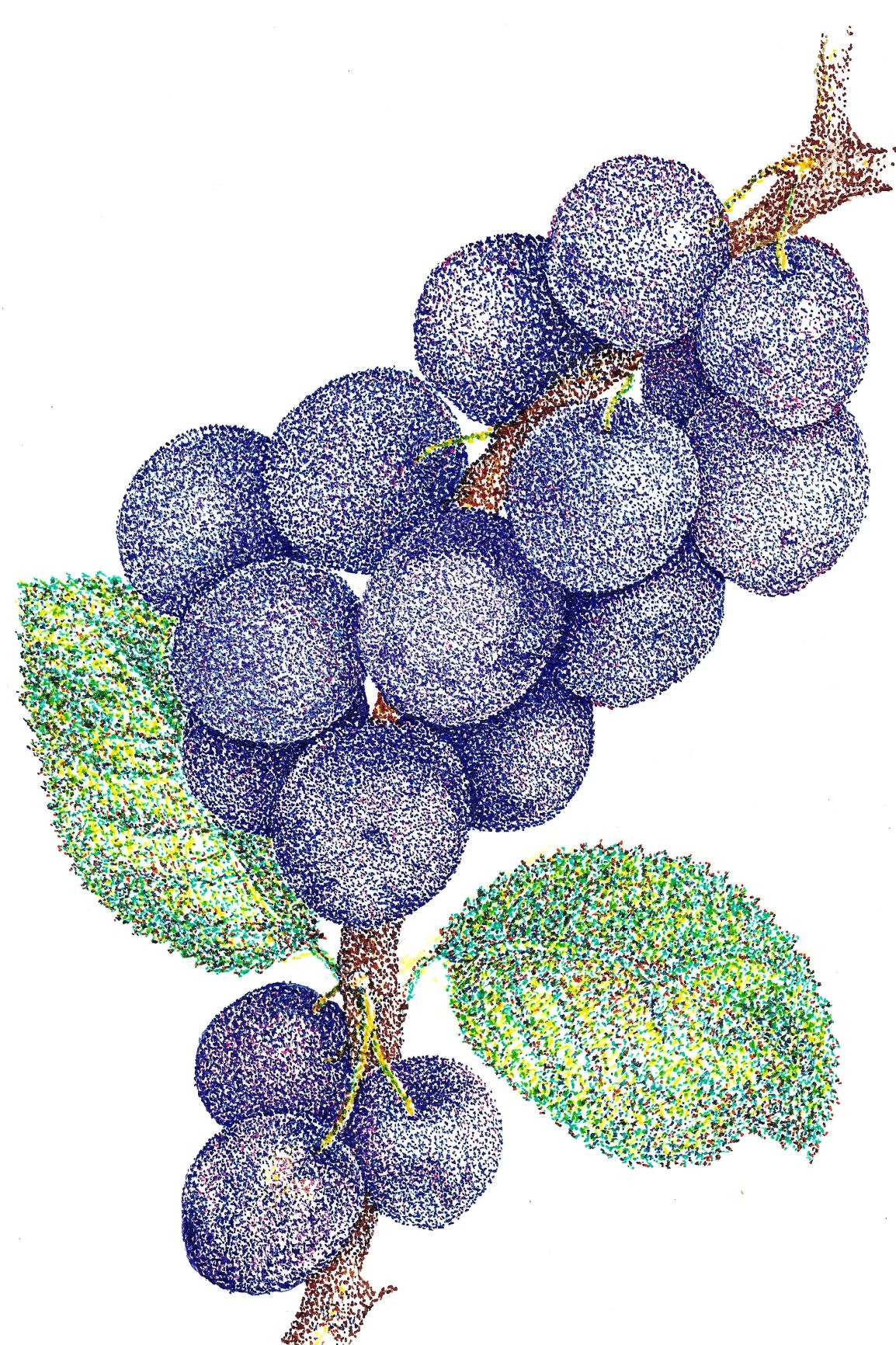
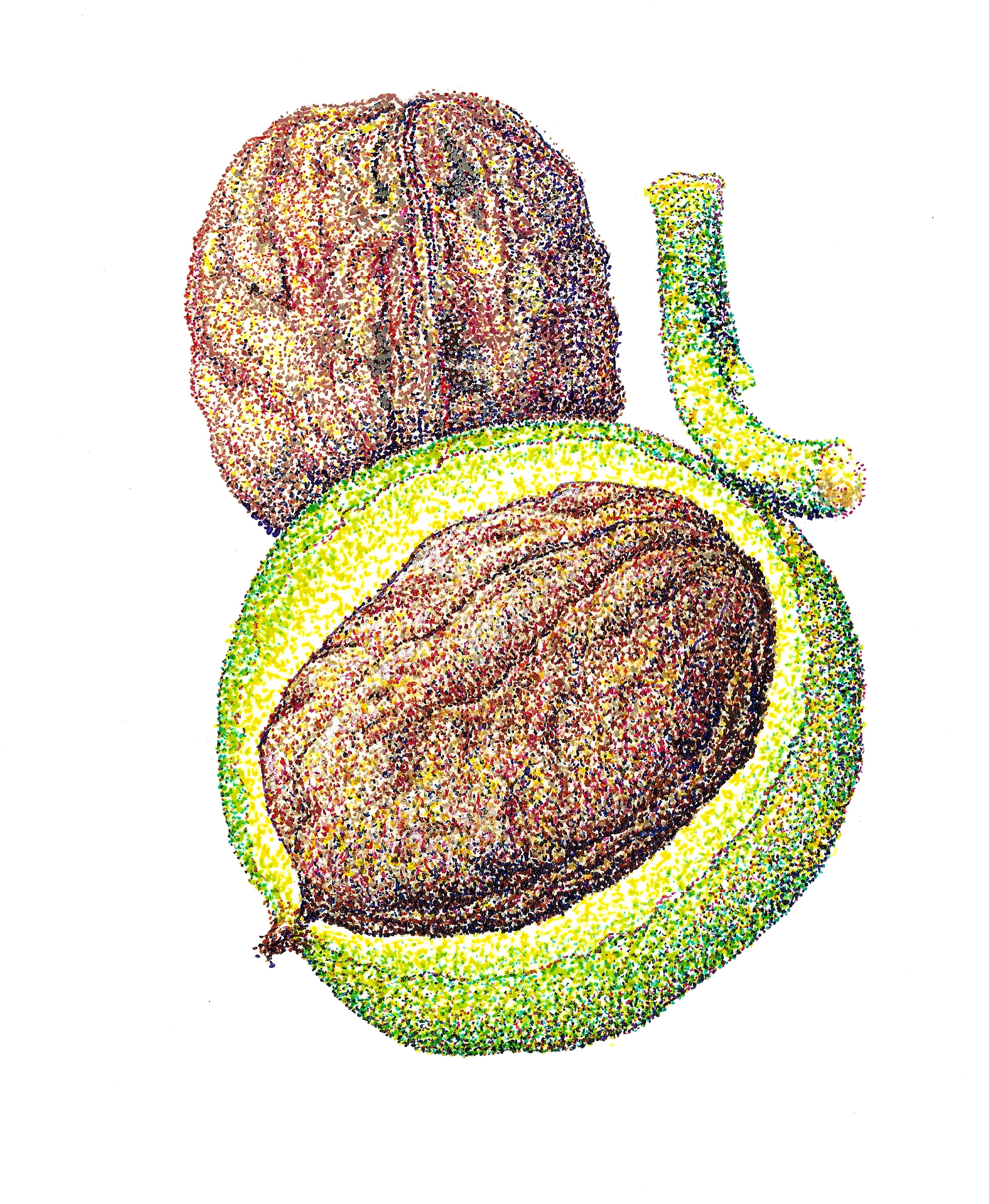
Prunus maritima Artwork by David Adams Above image is Carpathian English Walnut David Adams copyright . For use see the website directions for purchase.
Farmerless fields can produce the genetic diversity we need in an effortless manner which in turn will help us feed all of humanity with a healthy crop diverse diet.


 biologicalenrichment
You must be logged in to post a comment.