
Have you ever looked at the roots of plants closely? The part of the plant you don’t see is incredibly complex. Since I used a shovel to dig all the plants for my nursery I soon had a birds eye view of roots of many species of trees and shrubs. They were all different. You can look at the roots and see immediately what species it was. It is distinct as its foliage. I grew hundreds of species of trees and shrubs in beds that were tilled and planted with seeds. Because the medium I was using was very uniform created with lots of tilling, fertilizer, raking and mulch the roots of each species grew unobstructed creating patterns that you normally don’t see in uncultivated situations. Each species was different and followed certain structural designs. Within the species you would find unique variations the same way that you might find a variety or selection that has a different growth habit or foliage color. It is this variation found with the potato I found extremely interesting. It was not the tuber but the roots surrounding the tuber that caught my attention.
No one really thinks about roots. In the potato, the tubers are the focus. Recently I was reading a story of a selection process used for potatoes developed specifically for Texas done by actual real life plant breeders working for a university. It was a fantastic success story like winning the lottery of potato growing. There was no mention of the root structure of the plant growing in this hot arid climate. Instead they discussed the foliage and the yields. I was wondering if irrigation is required or how that works in a land that was not particularly potato friendly. I was thinking more about the roots again.
At my farm I began using seedlings of heirloom potatoes. It was by accident I noticed a couple of potato seedlings that had what could be described as a form of ‘compacta’ roots. Compacta usually describes yew varieties that are extremely dense in branching. They have a growth pattern where you have dense clusters of branching to the point there is often no leader like a normal tree or shrub. Often these are dwarf varieties never require pruning and are the opposite of all yews used in the landscape trade in the last one hundred years. Compacta is found in roots too but it is not common. You could easily say all roots are compacta because of the nature of branching in roots. For me it is a matter of density and structure. It reminds me of something I read in college about the emerging field of particle physics. My split ends are getting split ends. Ad infinitum.
Due to this clustering root habit compacta roots extract more resources from the soil much faster being able to attach itself to the soil particles in a way that the water is more effectively absorbed. It doesn’t just whiz by in the soil profile. It is caught working its way through the root maze. This creates a condition where the potato grows and ripens faster and finishes much earlier than other selections. That is exactly one of the characteristics of ‘Tranquility’ potato. It is a miracle to me but not so much to a crop scientist. The potato industry is laser focused on the varieties it already has. You can buy organic potatoes easily but it is rare you will see organic potato chips. Why is that? The whole industry requires certain criteria for certain varieties and sometimes it does not happen. Compacta roots is not one of those criteria needed for potatoes as far as the industry goes. It would take too much explaining. It definitely will be important in the future and any crop plant that can do more with less will eventually overtake standard older varieties because there will be no choice but to change. This will be the nature of all crops where the custodians hang on to old text books long outdated by extreme weather events and other related diseases and insects using conventional thinking. “I have one problem. I need to fix this one problem. I will find one solution.”
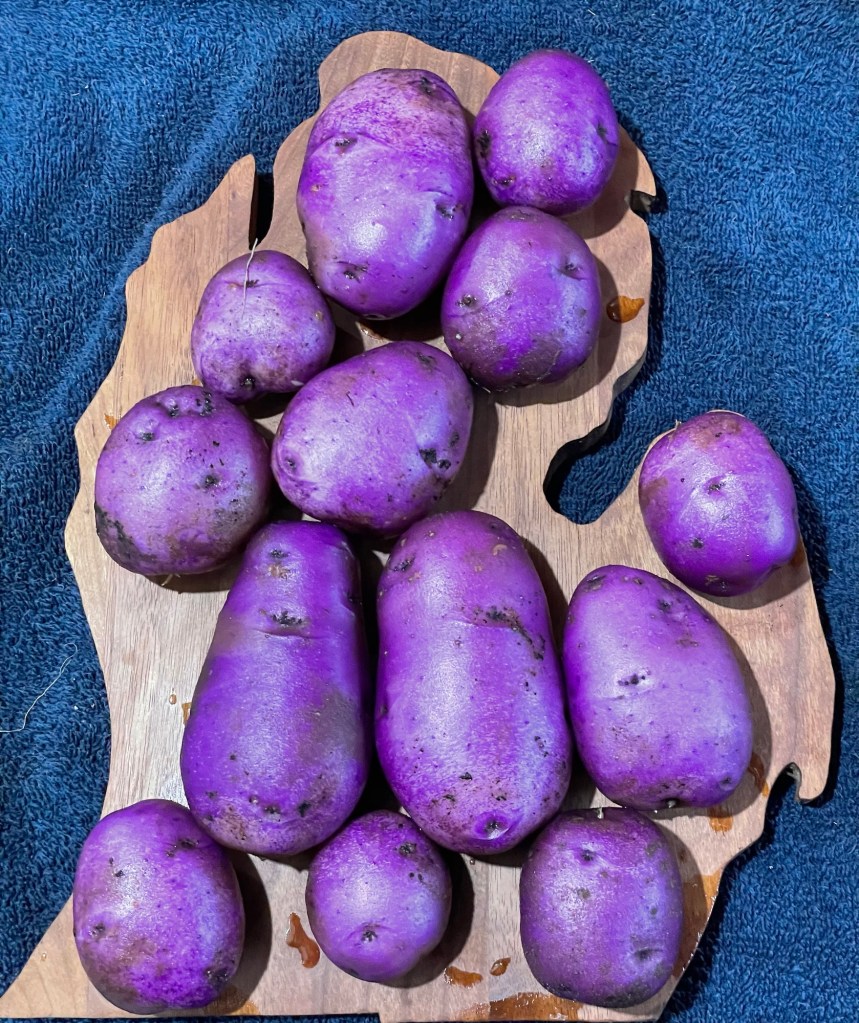
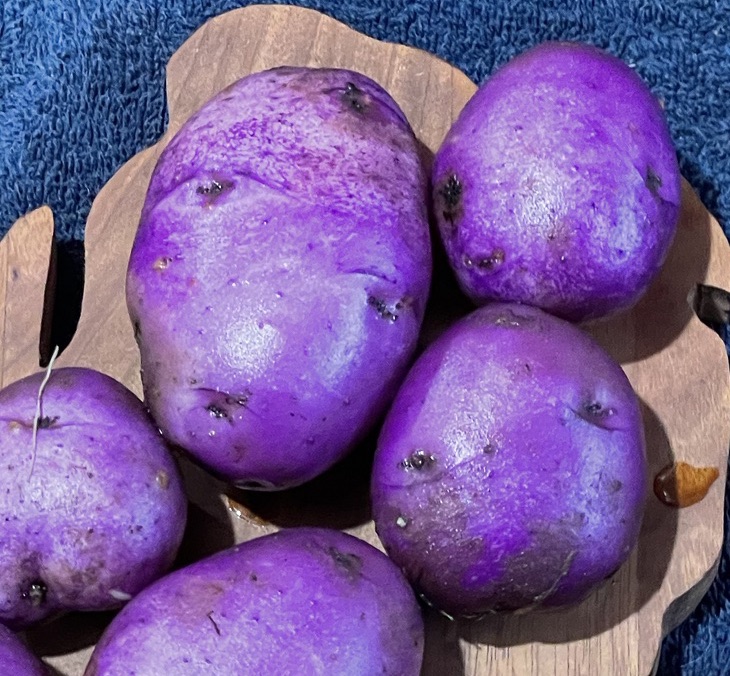
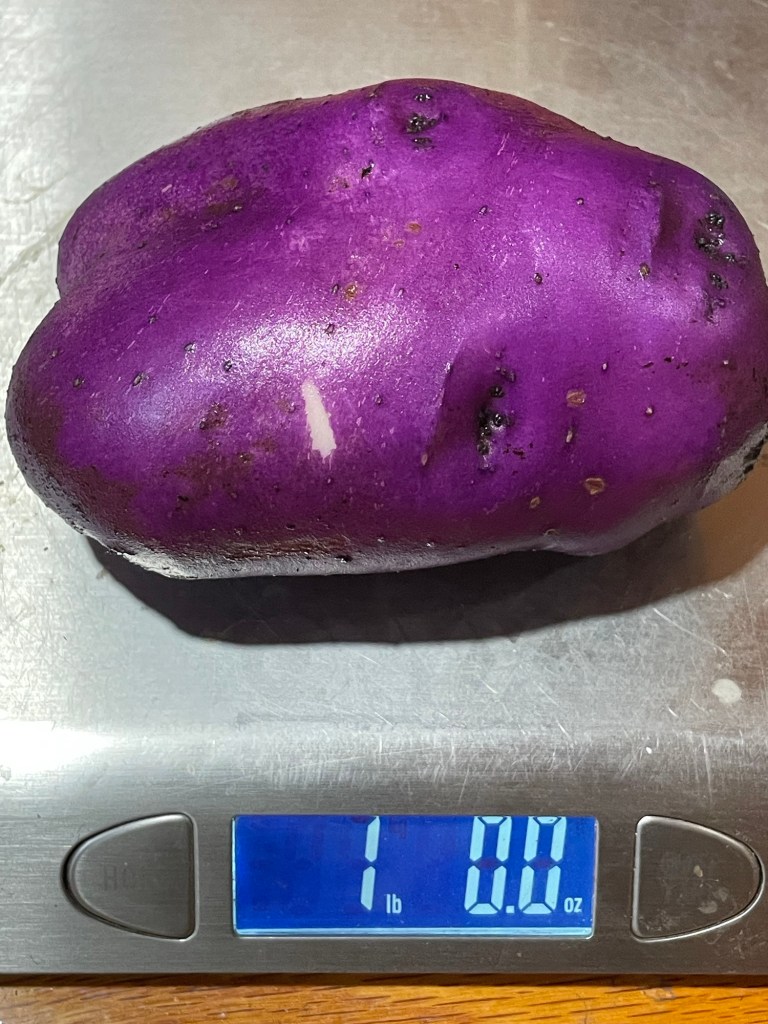
‘Tranquility’ makes the case for a short season high yielding potato. Planted in early May, the crop is ready to harvest by August 1st. I would put it in the 70 day range for ripening fully from emergence of the foliage to finish. The foliage has been free of early blight with no signs of heat stress. The top begins to go dormant in late July and decays quickly making harvesting very easy. The foliage remains clean throughout its growth cycle and appears totally insect resistant. The main stalk is square in shape with a pyramidal struture to it from soil level to the top of the plant. The tubers are clustered tightly around the roots near the main stem. I hope to measure yields more precisely this year. Sizes run up to one pound each. The bright purple and violet color is distinct and desirable from a retail sales level. The potato has a pure white interior with a very smooth and creamy texture. “Tranquility’ was grown from seed of a blue heirloom potato of which may have crossed with ‘Zolushka’. It was found in a seed bed that overwintered several years before I started noticing the yields which greatly exceeded all other seedlings I had grown up to that point. It is uncertain if it is entirely winter hardy. It does have very good cold tolerance. Although grown from a diploid, it does not produce berries. I am not sure of the storage qualities but at my farm it could stay at room temperature for three months prior to sprouting without refrigeration. At this time, I cannot detect solanine but will have a test done with this along with yield data.
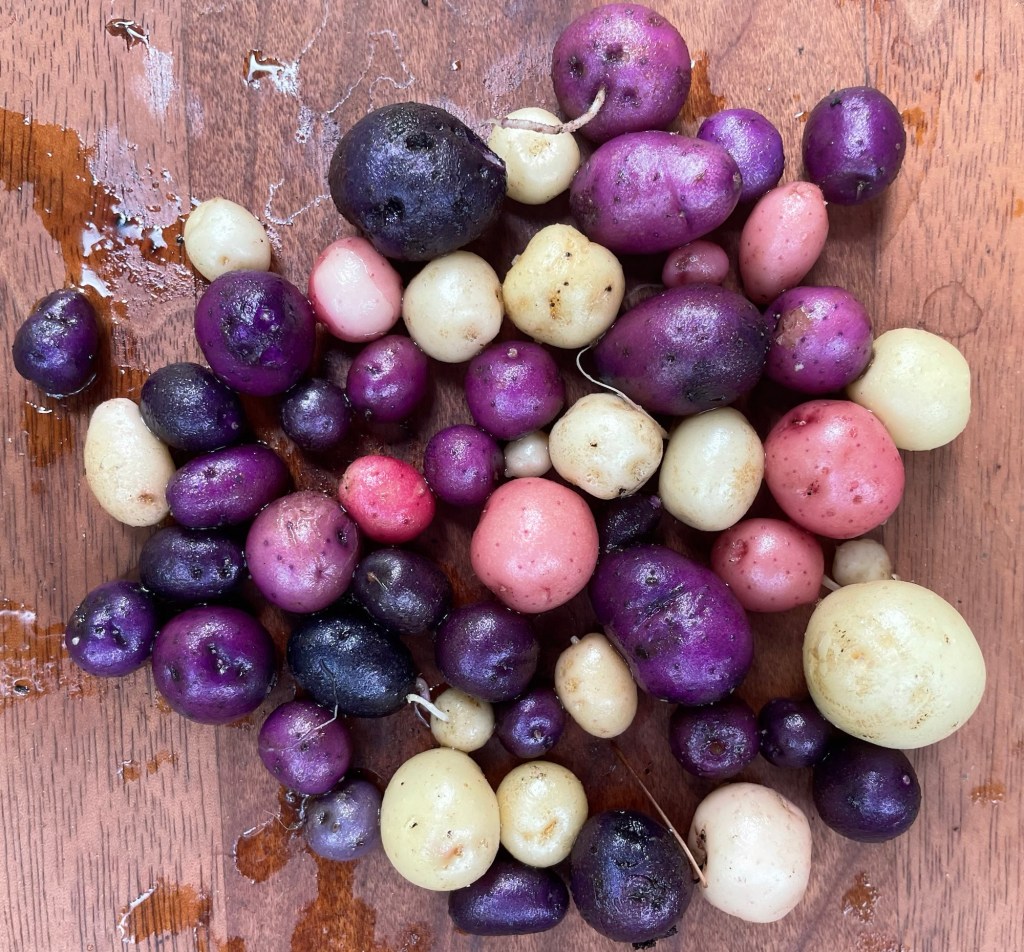
There are many characteristics of plants often overlooked because we view them as quirks of nature with little value in terms of use by humans. It is these quirks that provide an insight into a life of a plant as we pursue its growth from fruits to roots and back again.

Farmerless fields can be a bright spot on all farms where out of nowhere new varieties are born done by the almighty power of nature.


 biologicalenrichment
You must be logged in to post a comment.