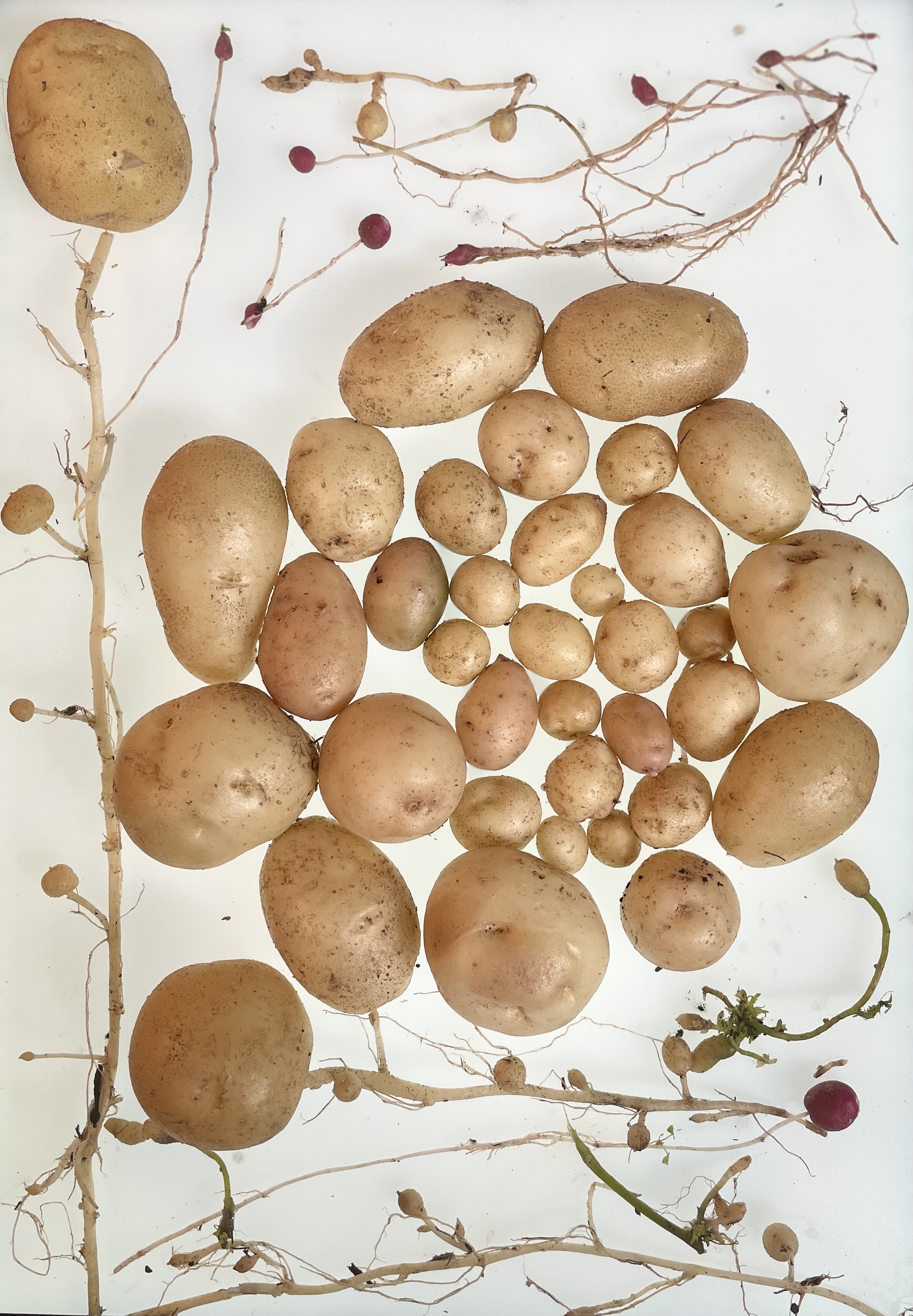
Its a funny thing to talk about potato roots. It is for my audience of one. I can clear a room discussing potato roots. Need help getting rid of guests that stay too long? Let me talk to them about my potato roots. Soon your house will be empty. Yet there is something very inspiring about roots because they are the unseen and unsung heroes of the plant world especially with the potato.
It was a set of unusual circumstances that created this dialog of roots in my mind. I was digging many diverse varieties of Jerusalem artichokes for my nursery. The roots on some selections were long with pure white rhizomes stretching out several feet from the parent plant forming a tuber on the end. It was like the mint roots of sunchokes. You could not stop them other than put them in grow bags where they would spin around in a soil mix that made them feel like they were in hyperspace. Why is it that potatoes are not like this? I thought it was a good structure in terms of its ability to reproduce itself as a perennial plant. You had both the storage as a tuber plus movement through the soil to new locations. You would still harvest the potato, but you would leave behind a small string of mini tubers for the following years crop. If you decided to harvest the small string you would have next year’s crop. You would then put it in your refrigerator crisper for winter. Being quantum has its advantages as you could easily store several hundred teeny tubers in a zip lock sandwich bag. I liked this idea as a form of wild potato where the roots play a dominant adaptive role in the soil. I needed a means to do this reliably so my search for potato root structures began.
To do this you need true seed. True seed is extracted from the berries of potatoes. Here lies the source of all potatoes. Having access to my own true seed allowed me to see this wonderful variation as a seedling population. Just like plums and apples, without the variation you have nothing. Potatoes also inherently have a type of superpower where previous generational traits can show up unexpectedly despite being hidden for generations. I began to notice some seedlings that contained both rhizome type roots that spread out far and wide as well as clumpy roots. Clumpy roots were a mesh or lattice of roots that had very tiny tubers. They were often under 1/16 of an inch in size after a full year of growing them from true seed. My guess is a normal potato breeder would have thrown those out because you cannot make anything with those. One million potatoes later you might have enough for a bowl of mash potatoes. Personally, I thought I hit the lottery of potatoes because finally I had my sunchoke type root system. Never mind the actual potato you eat. I had the roots! Jackpot! This clumpiness characteristic was not a common occurrence clocking in at maybe one seedling per 500 in my populations. I began to collect them and grow them out to see what the effect would be as well as take a look at flavor and yields. I was trying to emulate the wild potato that hangs on the rocky mountain slopes of its homeland in Peru.
The sunchoke like potatoes were highly diverse as well. Luckily most were incredibly productive small white potatoes which were uniform in color and size. The actual roots that I was hoping to save in my crisper this winter faded and dropped off. Luckily a few had continued their quantum versions of themselves on a string in the second year just like my Jerusalem artichokes of yesteryear. The combination of selections or specific varieties derived from them would be very good in small spaces where the root real estate is limited. This type of competitive advantage with other plants nearby would be an advantage in prairie, field or the slow conversion to tree crops where they could easily be used as a foraged food. The tubers grow close to the ground and do not require digging with a shovel. They create a sod lattice of tubers densely packed next to each other all of which are easily picked by hand. Their life creates a food opportunity where none existed before. In a pot, on a wall, in a flat, near a sidewalk or in a field the quantum tubers can find a way, replenish themselves and grow ever closer to their wild cousins rich in nutrients far beyond their cultivated and esteemed varieties. And to think it all started from one potato.

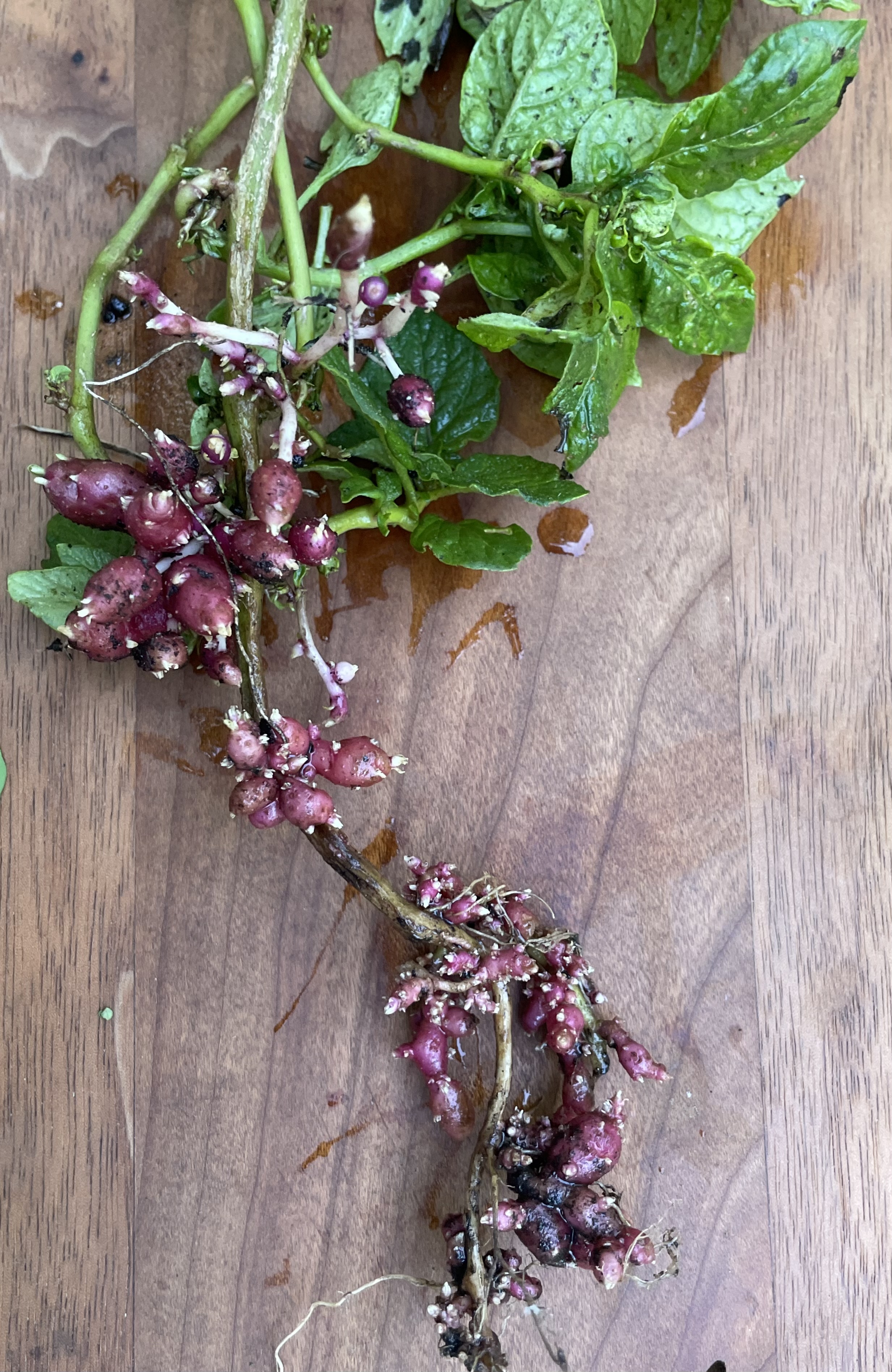
The above seedling selection was done using similar clustering potatoes on long strings showing a ‘compacta’ trait in the roots. Like the above ground branching of yew bushes, potato roots can follow a similar pattern with a ‘my split ends are getting split ends’ sort of particle physics.
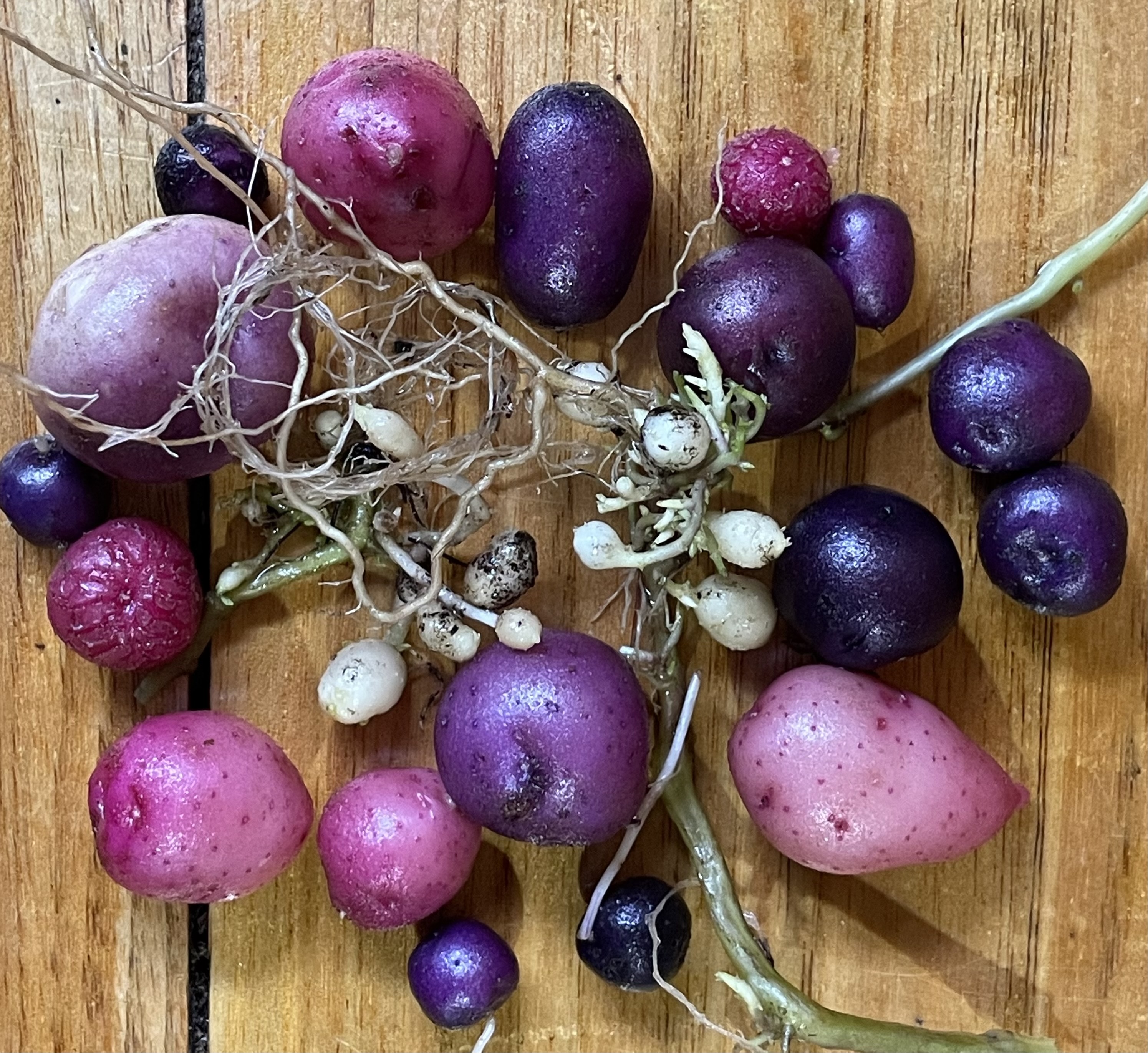
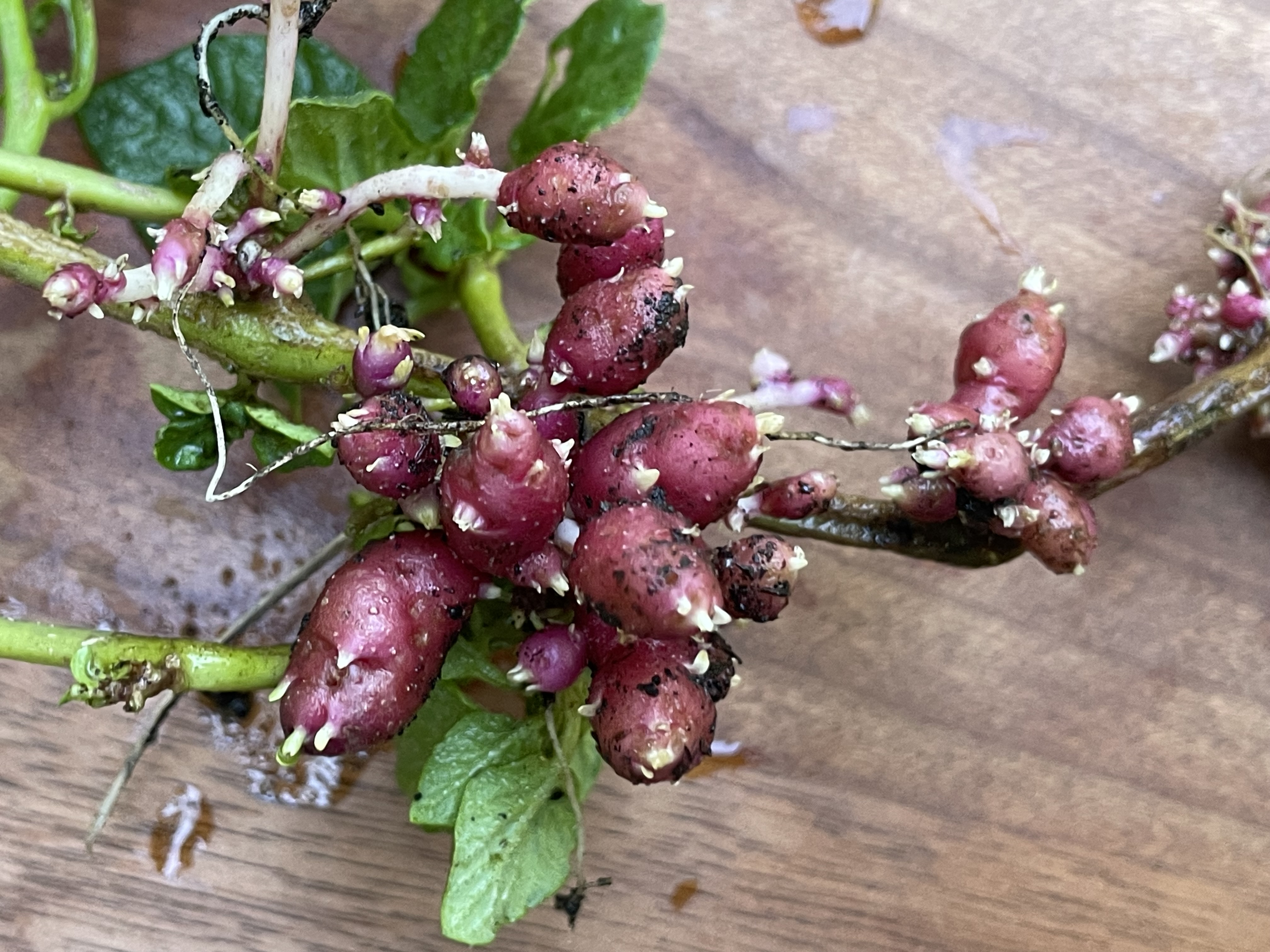
With plants you might find a solution that appears to be the opposite of everything else. It emerges from the pool of all genetic possibilities which is equivalent to the biological quantum mechanical realm in nature. The potatoes are found on a long string which are generational possibilities that are retained within its ancient genetic structure. Then under the right conditions it can express itself. The potato is changing to meet the demands of this new world environment. These changes help us enjoy the nutrition and flavor of this wild potato which addresses some of the current means of cultivation and its continuation as a wild species on all continents and climates. Humans can connect with this same realm and realize it in terms of practical applications.
The potatoes featured in this article will be available for purchase starting in the fall and winter of 2025-26 seasons. It will be a collection of at least two selections know for its heavy production of small tubers. It can be purchased directly on the Oikos Tree Crops website under
Enjoy. Ken Asmus


 biologicalenrichment
You must be logged in to post a comment.