
It is always a surprise to me that a wetland tree found only in swamps, back waters of streams and lake fronts will grow outside of it’s specific low oxygen and high moisture location into the front of the average home. In Michigan, we have white cedar swamps filled with rich black soils and huge amounts of decaying logs and peat moss. There in the midst of rotting wood and high water tables white cedar, Thuja occidentalis, thrives like no tommorrow. However, it is also very easy to collect seed off these trees and propagate them in open field conditions that corn used to grow. There is a range of adaptibility within these species trees that make them ideal ornamental trees. It says alot on how many varieties there are of American arborvitae. It can grow pretty much anywhere and is easy to cultivate as nursery stock. For a while I tried growing many species of larches following this exact same scenario and ideal. I tried various American larch seed sources here in Michigan including one massive tree I climbed up on vacation. I made it to the top and and collected a bag full of cones. Larch are quite prolific in cone production. American larch also inhabits these wetlands where few trees survive long if at all. It is very specific in its soil requirements. No matter how I amended the soil or took care of my American larch, they failed transplant long term. It would be like trying to grow cattails in a desert. I knew that not all wetland trees had this wide range of soil adaptibilty needed for widespread cultivation.
It was with this knowledge, I proceeded cautiously with the Atlantic white cedar, Chamaecyparis thyoides. Not related to the white cedar here in Michigan it too was a wetland tree with very specific soil requirements or so I thought. I was given the seed from an arboretum collection in the midwest and grew the trees in my polyhouses. My polyhouses were very inexpensive to build but high maintenance in terms of managing a crop. Not everything grew well in them. The polyhouses were 96 ft. long and without fans. Prior to using shade cloth, it was super hot in there with insane moisture levels in the summer. You couldn’t just waltz in there during July where it frequently would peg the thermometer to the top of the 120 F mark. One sashay through there and you looked like you went for a swim. Yet it was from here that the Atlantic white cedar seemed to thrive. My employees not so much. So we put limits on when to go into the greenhouses and picked cloudy cool days in the mornings. Although I did kind of have fun taking people in there on purpose and waiting to see what they would say. People were like trees too. Some did not seem to care with rivers of perspiration running down their face while others had that look of Jesus-I-need-to-get-the-hell-out-of-here-before-I-die in their eyes. Apparently this east coast U.S. species has a very narrow and spotty range in the wild and is only found in wetlands and bogs rich in the same soils that Michigan white cedars grow in. I was still skeptical that it was a long term tree crop because it was under irrigation in the mega sauna polyhouses with help from my nearly passed out employees giving them water and fertilizer on a regular basis. Relax, no one died in the growing of the Atlantic cedar trees.
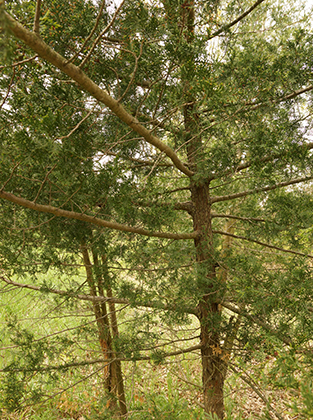
Eventually I relenquished and took a few of the best trees to my outback and placed them at the base of several hills that I have at my farm. There the top soil was deeper being nearly triple the depth compared to other locations. The exposure to low minimum winter temperatures was very good here to at least minus 27F once plus drying winter winds. Never underestimate dry winter winds when it comes to evergreens. They thrived and continued their growth in a very uniform and stately evergreen fashion. I was home free and so were they. Michigan works for them and so did the non-wetland soil conditions I had them in. With only a sprinkling of sawdust, the trees began to fruit and set cones and we started collecting the seed. The seed was extremely tiny and difficult to get it to pop from the cones. This tight winter opening cone allows the seeds to be slowly dispersed as they land on the black low nitrogen soils and organic material found within their wetlands. In the meantime, we we struggling to clean the seed properly despite all sorts of screens and drying proceedures. I noticed for a while the national cost of the seed is over $2000 per pound. It’s not easy to get either. The trees are not safe or easy to climb like larch or spruce. It explains the cost.
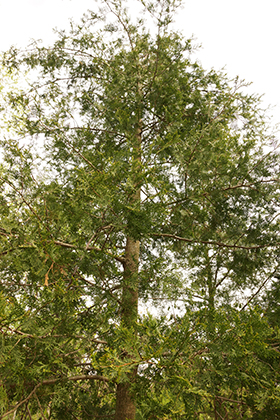
The germination takes place over the course of three years. It is the normal cold dormancy but few plants pop the first year. It is during the second year, the seeds sprout in great amounts. The seeds sit on the surface of the soil and wait. I think this might be due to both a chemical based dormancy as well as the embyo has yet to fully mature. This would be the reason for the first dormancy to start the growth of the embryo to maturity and then the second cold period to overcome the chemical compotents of dormancy. One of my tree friends told me ‘heck with that’ and he froze his seeds in a block of Canadian peat moss and water. He said that really kick started it. When I looked at his propagation bed it did appear more came up the first year but I was not seeing that many trees out of the gate. So I think the second dormancy is ideal for the plant to succeed. I have seen some seeds go into their third year as well if conditions are not met. This is just a fantastic survival mechanism yet frustratingly slow if you are a nursery person.
The Lakey Flake Test
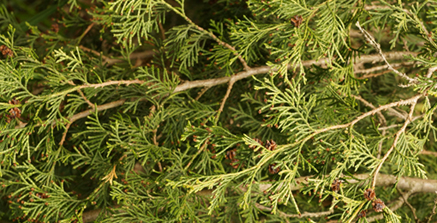
Being in southwestern Michigan means having snowstorms of the lakey flake type created by Lake Michigan and its moisture rich air driven high into the sky and unloaded with great abundance up to thirty miles inland. This can create massive snows which can be light and fluffy as well as sticky. A few times I visited these trees during the lake snows and found the normally 15 to 20 ft. high trees bent to the ground barely reaching 4 ft. tall. I thought for sure they would not survive. It created a type of tree by pruning where half the tree would split at a narrow crotch angle. Many of these trees showed this propensity which is very unusual for evergreens because most tree folks would call that a weakness and to get out the pruners. This ‘errant’ limb would still be attached to the tree but would now be parallel with the ground with branches that would cover my pasture grassses. It is very tempting to want to prune those too but I kept one that dropped all the way to the ground to see what would happen. The result: More upright growth on the parent tree and new ‘trees’ emerging from the stem growing in an upright position. It looked like a line of new trees attached to a log. This is how the tree survives the east coast storms from the Atlantic. It likes the wind. It helps the plant reproduce. I am sure in a wetland envirnoment the limbs would root into the wetland soils and mulch. It thins the crown and makes the tree stronger. This is quite a wonderful solution to wind and snow born events. The other aspect to this tree is its needle thin foliage. It is not a particularly lush rich evergreen tree with massive amounts of dense branching. It is meant to let the wind blow through while at the same time produce copious amounts of seeds all which sprinkle down on the soil below with perfect timing. I beginning to appreciate the value of this tree and how it can do all this so simply.
There are some interesting information of this species on the Wikipedia page. Here is something to consider from my experience with this wonderful tree. It needs to expand its range and we should help with this. I would love to see colonies of it here in Michigan but I would also love to see it as a landscape tree throughout the United States. It has an ethereal look to it. I know that the wood is quite impervious to decay and could easily fit into todays woody ideals in terms of agroforestry and timber production. Another aspect of it relates to establishing it on the east coast. It would be a complete waste of time to remove invasive species or use herbicides or create any number of short lived conditions by these methods for the sake of the Atlantic white cedar. It doesn’t need any of that nor will it help. That would only interfere. The reason is the plant itself is fully self regenerative and self sustaining once you get the populations established which I have discovered to be extremely easy. It is ignorant to think of it as an agricultural crop in some way and then blast everything back to 1491. It doesn’t work that way. The whole mineral based and peat soils are rather sensitive to these disturbances you might call ecological restoration. Think of yourself in a very hot polyhouse. How does it feel for you? Not too bad today? Is it too hot? Can you enjoy the sauna? You look over to your right and see the Atlantic white cedar is there pouring water on the hot rocks. “It’s cleansing and refreshing” says the cedar in a calm, cool and collected way.
That is what they do. Clean. Refresh the world.
Enjoy, Kenneth Asmus


 biologicalenrichment
You must be logged in to post a comment.