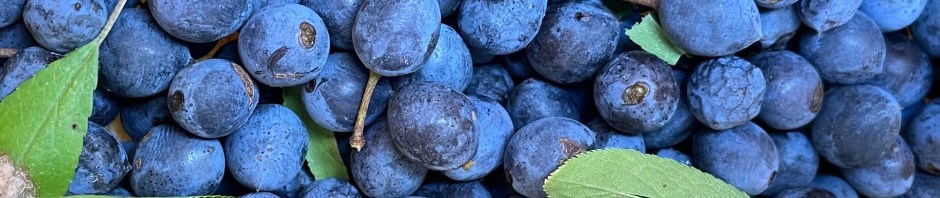
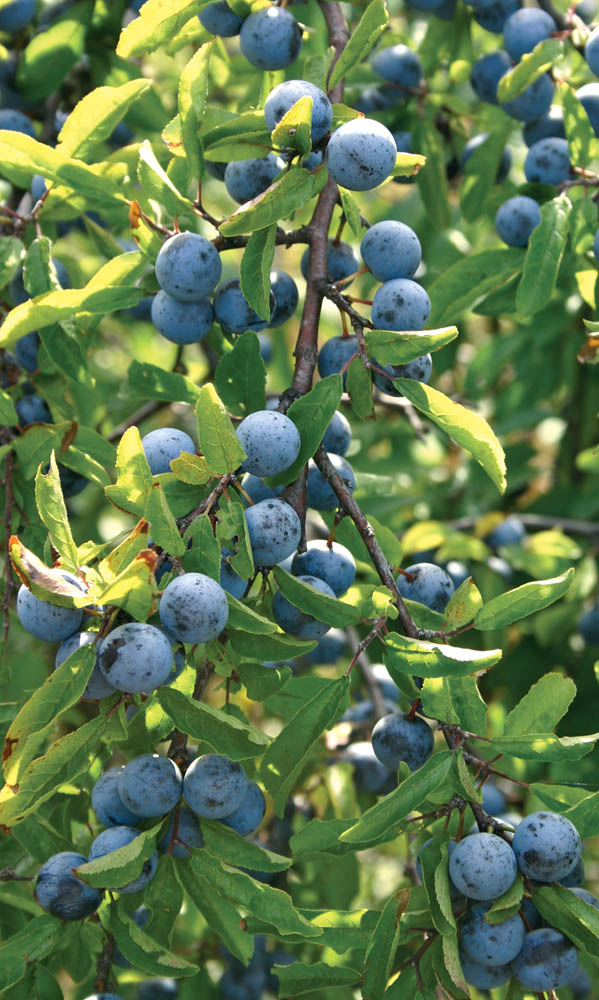
Within the first decade of my tree farm I planted many wild seedling fruits on my farm. Some of these are the wild crop relatives of sour cherry, sweet cherry, plums and apricots as well as species that are wild collected and not in commercial agriculture. I grew everything from seed. I knew that the genus Prunus had many untapped species that could be used for food and drink. I was particularly interested in the jelly, jam and syrup fruits. These would be fruits that would require cooking with sugar or processing in some way to be edible. I knew from my readings that many had potential health benefits. I thought of them as a treasure chest of nutrition that could be spread on a piece of toast. One of these plants was the sloe plum, Prunus spinosa. It was not available in the nursery trade. I began growing a selection from seed called ‘Plena’. ‘Plena’ was a clone known for its heavy flower production. Sloe plum was not found in North America as a wild plant. The arboretum seeds that I received were a welcome surprise from a friend here in the states who sent them to me. I originally produced about 25 plants and planted them on a hill that was sand with two inches of topsoil. There in two foot tall Tubex tree shelters, the sloe plums made their debut in North America. After several years, small flowers were born in clusters followed by a few fruit. This continued for another 10-15 years. By then I began to see larger clusters of bright blue fruit and the spur type sharp thorns. The thorns are a common characteristic of the plant and gives it its second common name: Blackthorn. It was one durable little shrub. Picking fruit one by one is a challenge without getting stabbed. It requires very thick gloves and a methodical movement within the thicket to prevent blood shed. It’s a dance done with canvas carharts and rubber gloves. Be nimble my friends.
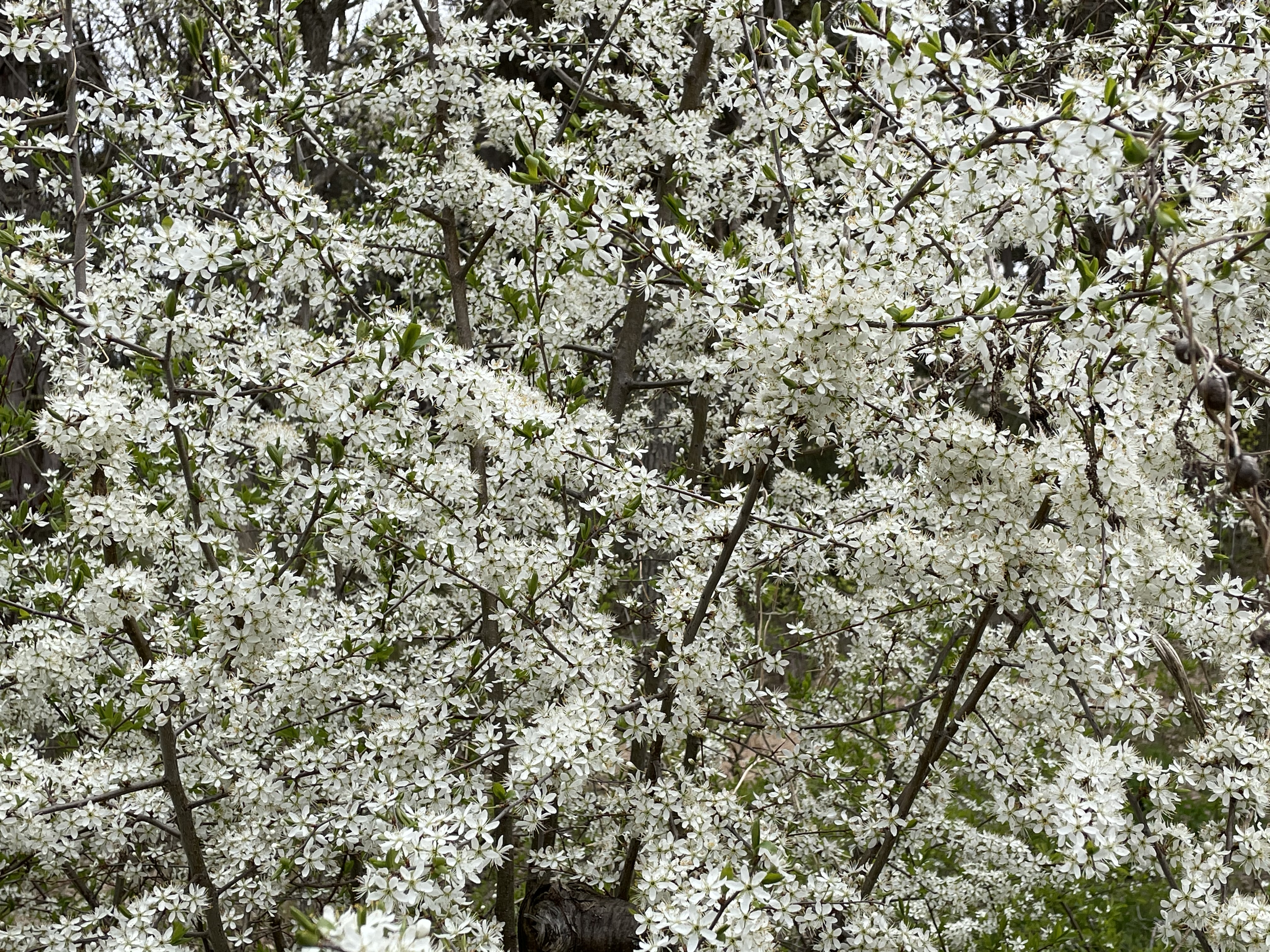
I began creating new plantings on my farm with the seedlings I was growing. To be honest, few people had knowledge or even knew what this plant was. I began asking others if they had any personal experience. One person told me ‘It was invasive’ and another sent me a fruit recipe which included vodka. Another person shared with me how to make a shillelagh with the canes of the plants. When I investigated the claims of invasiveness, it was turned out to be completely false. It was based on its habit of growth. Sloe plums are stoloniferous and like many plants that have a running root system away from the central plant, this tendency is a strength not a weakness. You can use the plant’s root cuttings to propagate it and distribute it further. As an orchard plant, you can use it for creating a fruit planting of the best selections bypassing grafting. Grafting is very short lived compared to in-ground clonal root systems which can go on essentially forever constantly regenerating itself. That’s a big plus especially for sloe plum because the fruiting canes fade with time after a decade or two and need new sprouts from the roots to replace the older parts of the plant.
At one point, someone said I had the only planting in North America, and it was of great value in terms of its use for flavoring. I was very happy of the results of the plants. But I was still in this la-la land of no disease or insects when you first grow a new species. Unfortunately, a disease called black knot showed up. This is a very common wind-blown fungus which infects the branches. It is a disease which completely destroys the plants ability to transmit food and water to the leaves. It encases the stems and the plant eventually dies. My planting which had now stoloniferously spread to an area 20 feet away in all directions from the original plants retreated dramatically. I lost over 90 percent of my plants. There was little left except for the burnt looking scab infested knots on the branches. Another planting I had done about a decade later did much better, only loosing 50 percent of the plants. The black knot fungus is a great equalizer and removed the weak plants in the process.
Another not mentioned characteristic was the mouth numbing flavor which makes it nearly impossible to eat fresh. The incredible tartness and astringency has to be processed to enjoy. Yet this too is part of the plant. If someone were to eat it off the bush, they would clearly state it was not edible. Of course the 5000 year history of it being used says otherwise.
Eventually those few plants showing zero signs of the disease despite being in the middle of it all, took over the area previously occupied by the diseased plants. It even grew under the trail road we had near the plantings and continued into the nearby hawthornes and evergreen oaks. The disease is still there but it does not infect the seeds which cannot pass the barriers within the seed. Every generation starts new with no black knot disease. Seeds purify and maintain the germplasm so each new generation retains its place in the population free of disease. Once you have the disease, it is too late for methods of control. The spores eventually whittle the tree down despite pruning and spraying. I called this immune variety “Ocean Blue” and now both the population and the original selection or individual plant is used for growing sloe plums.
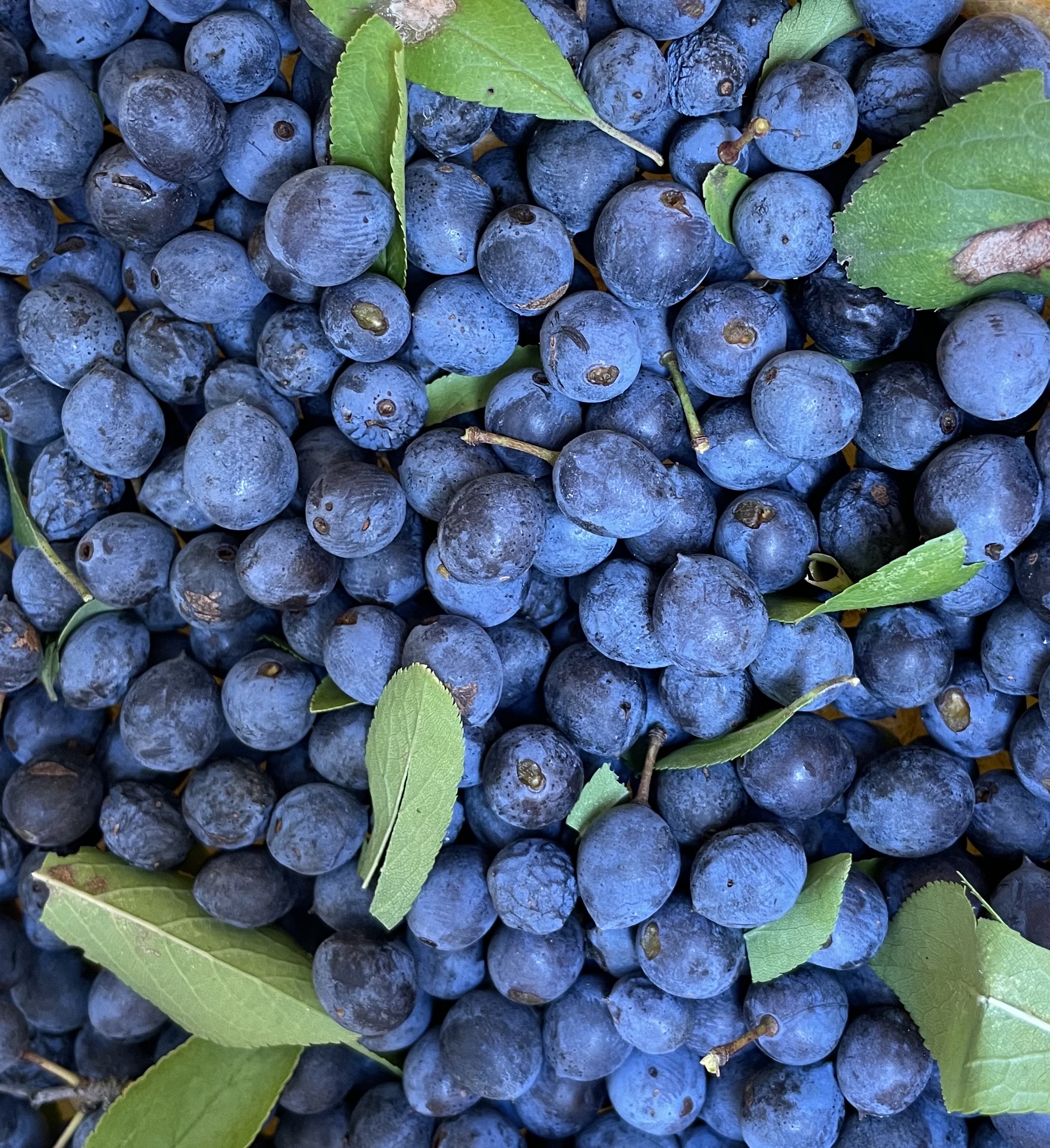
Today a few sloe plum plants are being grown by distillers and a wine maker. They purchased a lot of the seeds and plants when I grew them. The astringency and sharpness of the tart fruit made me wonder how it would be possible to process. In Michigan, the fruits ripen in July and will remain on the bush in good condition through August or later. There is no frost on them to any degree to improve the flavor. The green interior and astringent blue skin is very distinctive part of the fruits flavor. It probably also protects it against insects and disease. The fruit has no problems in cultivation and could easily be grown without sprays. Nevertheless the plants cannot be shipped to California, Oregon and Washington all based on outdated or out right inaccurate scientific information. But the seeds are allowed.
One unusual seedling popped out of the population that surprised me. It is a unique hybrid plant I cannot entirely identify. It is a small tree with runner capabilities as well as incredible floriferous tendencies. Every year I am stunned by the beauty of this tree and its dense flowering. Bees flock for miles around to visit. Yet there is no fruit. To solve this problem, I have to go the extra mile and bring in other individual plants that are genetically different yet not too different and await fruit set. I have some new sloes from other growers that I plan to use right next to it. Some of these diverse populations are crosses with plums known for their larger fruits or have a unique flavor profile and are naturally occuring hybrids of Prunus spinosa. They too are all grown from seed at my farm. My lone hybrid plant needs some overlapping flowers of related species that will be compatible. It would be best to just use the sloes on my farm by planting a few seeds with a dibble a few feet away from the trunk in all directions. This surrounds it with neighbors that will help each other in their fruit production creating great abundance in its wake. If you help one plant, then all will benefit from the diversity. The lone unfruitful plant will become fruitful and the others will respond with greater yields too as the pollen from the lone unfruitful plant may be useful too. It does not mean it has sterile pollen. This is the nature of the Prunus spinosa population all done in a sloe manner. I like the sloe way of life. One helps all and all helps one.
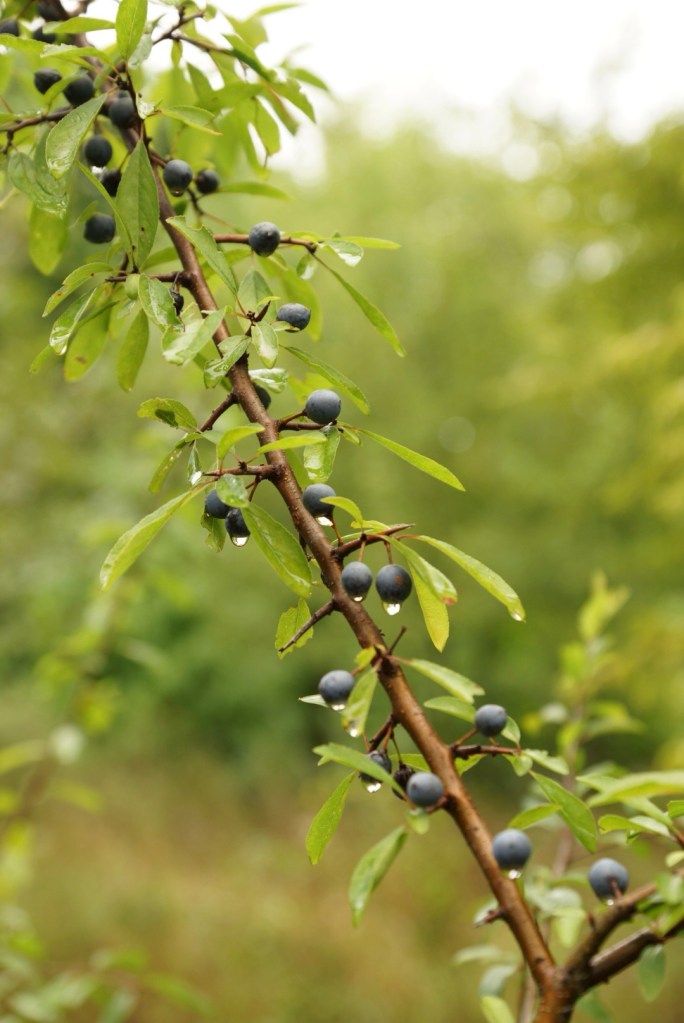
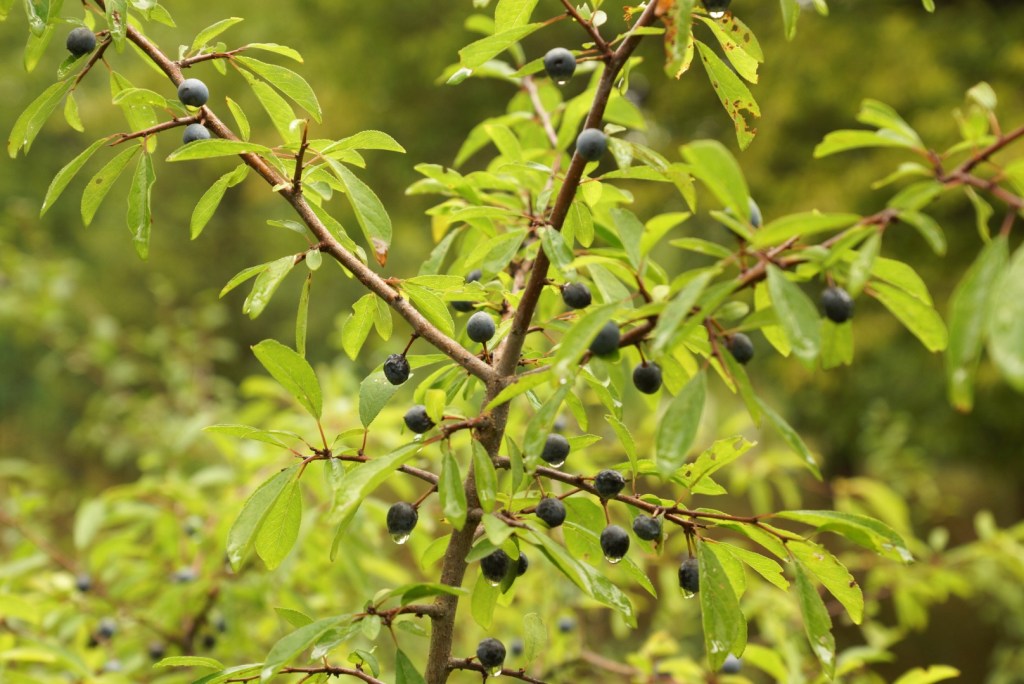
The foliage of the sloe plum plant is sparse so the clusters of fruit really stand out on the outer perimeter of the bush. Pruning is done in the winter to address branches that cross and allow more light to penetrate the hedge like crowns. You want plants that are accessible for picking yet not too dense to make a fortress of thorns. The thorns are actually fruit spurs necessary for flowering and fruit production. Cross pollination is not necessary as far as I can tell. However, no one has grown a single plant isolated to see if it benefits in terms of yields from other genetically different plants. It would be a good idea to have several plants as this plant likely has the same pollination types as beach plum where a diversity will increase fruit production. Some strains may have developed this on their own in isolation over time in the mountainous regions of central Europe.
A book worth exploring: Cornucopia II A Source Book of Edible Plants by Stephen Facciola Kampong Publications, Vista 1998.


 biologicalenrichment
You must be logged in to post a comment.