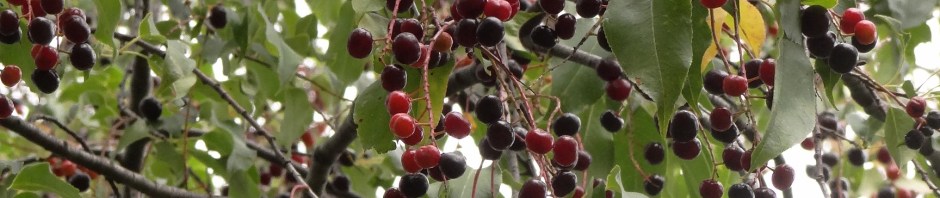
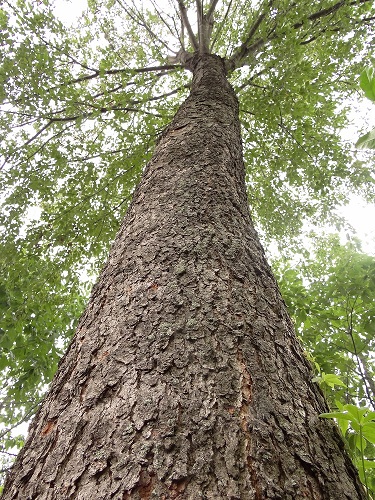
I did not grow the wild black cherry at my farm. It grew by itself. Today it self-seeds freely under my tree crops. It is a native tree found from Guatemala to Canada. This huge range has great diversity. Almost all of it is not explored by horticulture. It is the kind of weed tree mentality that sinks great plant ideas. Yet it is not that hard to select better wood and fruit selections because by and large they are all over planet earth. It is not some sort of rare treasure. I was a great enthusiast of the tree and kept the few that I had in my pasture. Those five trees along with two black oaks made up my forest in the beginning. I would climb them and put kestrel and screech owl boxes next to the trunk overlooking the pasture. This was successful and attracted these birds to nest on my farm. The idea was to lower the rodent population. I was planting a lot of food for rodents too. As the trees matured, it became harder to climb and put the nest boxes in stable locations where the wind would not blow them down. The last time I climbed, I lost the ladder and had to shimmy down the trunk while grasping the bark while clinging the trunk with my legs around the tree. Seeing the ladder fall with no one around within shouting distance made me rethink my love of predatory bird boxes. The Carhart pants I had on protected me and the future of my potential future family if you know what I mean. My back was stretched and out of whack so a series of Occupational Therapy treatments, medical massage therapy and yoga with a bit of Motrin thrown in got me to the other side free of pain and discomfort. I was always removing the lower branches of the trees to improve their form to a more Christmas tree shape with no lower limbs. They became unclimbable eventually. The image above shows one such tree that was one of the better timber-like wild black cherry. I named it ‘Sweeta’ because it had very little astringency and larger than average fruit size.
I was left wondering if anyone had looked at the black cherry in the same way black walnuts are grown. I also began to wonder if there were some plants with good fruit to eat. It had potential both for its fruit and wood. I only knew one person at the time who was interested in its cultivation. Funnily enough he lived down the road from my farm. He discovered by accident that the abandoned grape field he had purchased years earlier was soon the home of seedling black cherries that were dropped by birds while sitting on the trellis system, to the persistent herbicide strips below created by atrazine. Few plants can tolerate that, and it takes decades for the soil to repair itself. There in the dead leaves and grass the trees grew very vigorously. He had discovered that there were some seedlings that appeared super vigorous, and he began a process of selecting the strongest, apically dominant trees and removing the weaker plants. He said his major cost was buying a good pole pruner so he could do it from the ground. He was surprised at how fast the trees grew compared to black walnuts in this soil with minimal organic matter. As a wood worker and building contractor he also noticed at that time the price of black cherry lumber was equal to black walnut. Straight knot free logs were hard to come by. He also said that the selections he was saving seemed to be much better than the average tree either through cultivation or genetics or both.
This prompted me to begin a more thorough search of wild black cherry trees. Its interesting in that I discovered the tree far north of the range maps in the books. I noticed a few trees not far from Mackinaw City. There the trees were half the size of the trees in southern Michigan. I purchased seed of ‘Capuli’ wild black cherry from a commercial seed house. This was a native South and Central American form of Prunus serotina, wild black cherry known for its delicious fruit that could be upwards to one inch in size. Here in Michigan our black cherry fruits were around a quarter inch in size and barely edible in the ripened state. The Capuli cherries grew very well at my farm. They looked like peach trees with long willow-like leaves. Unfortunately, they did not survive the winter in Michigan. I kept them for three years waiting for some sort of epiphany while they kept sprouting from the roots every spring enticing me with their beautiful willow like foliage. The epiphany did arrive and like all epiphanies it came from an unexpected direction. It was in front of me. I began keeping track of some of the black cherries that were growing on my farm when I purchased the land. Over time these characteristics of fruit and lumber became more defined as I kept more seedlings on my farm as well as visiting a local sawmill that harvested trees in the area for wood. I began to see what would be desirable should one make ‘improvements’ for the species itself if it was under cultivation. Eventually I was able to find and grow a few trees I was searching for both for lumber and the quality of fruit. Did I solve a horticultural puzzle? Kind of, but frankly the mystery only deepened.
There was still something missing. There wasn’t a huge ocean of diversity. Wild black cherry is remarkably uniform. It was a pond of diversity versus an ocean compared to other species yet there was some wiggle room available to find and create selections. It turns out that the Wild Black cherry is an odd ball plant far different from other Prunus. It has many chromosomes which make it a stable tetraploid. A stable tetraploid shouldn’t exist or be fertile in any way. Nothing adds up to why this happened and even today scientists who have looked at it are baffled. It does not cross with anything as far as they know yet it self-propagates itself quite easily. It is widely distributed throughout North America and Mexico ala all naturelle. And it tends to be very uniform in fruit and species characteristics. There is only one named form of it that I have ever seen listed called ‘Asplenifolia’ which has long clean leaves. There is mention of large, fruited types in West Virginia. Every now and then someone will take out scion wood out of an older horticulturalist’s private home who had hybridized the Capuli with its northern cousins. Yet today these are still not available in seed or scion. This is the way of the black hole repositories with no intention of ever making it available to the public. Once they collect and keep, the story ends.
We may never know what the two trees were that created the stable tetraploid we know as Prunus serotina. Yet when you see both the chokecherry and pin cherry, you get the feeling they may have had something to do with it. They do share many characteristics, yet they have never been replicated on a scientific level. No one is lining up to do that anyways.
I have a wild chokecherry in my forest that is so different than all the rest. It is straight and tall growing upwards to 40 ft. amidst the black oaks and sugar maples. For a long time, I could not figure out what type of tree it really was. I started growing pin cherry at my farm and was surprised at the large trunk sizes I found in the wild and the ones I created at my farm done with careful pruning. This variation signals potential for selection and use in cultivation. Yet to employ this on a large scale through the selection process is very difficult. This is the same case for wild black cherry. Even if you did create fertile hybrids of it within chokecherry or pin cherry who would really care? If you build it, they will not come. It’s a novelty you are creating and discovering which is more art than science. My little art project cannot be practically applied because it is too far removed from modern agricultural food production. This is a common experience for many who do these breeding and collection of food plants.
Wild Black Cherry and Sweet Black Cherry
The cultivated sweet cherry we consume and is well known and grown in the state of Washington also has its wild counterparts. These can be both from naturalization here in North America and actual real life wild forms of it found throughout Asia and Central Europe. They tend to have teeny fruit. Once while at a fruit conference, an award was given along with a wooden bowl made from sweet cherry. It was a beautiful deep rich reddish black color. I was surprised. I did not know this tree could be cultivated for its wood. Inspired by this bowl, (an art project by the way) , I began a process of using seeds of wild forms in Asia and elsewhere and planting them at my farm. They too have potential in this same ‘field’ of interest. This too could be part of the overall cherry production using the timber forms found in Denmark as well as wild forms here in North America. Once again, the epiphany is in front of us. We need a symphony of epiphanies as a spur to action. I hear a cherry bowl. What do you hear?
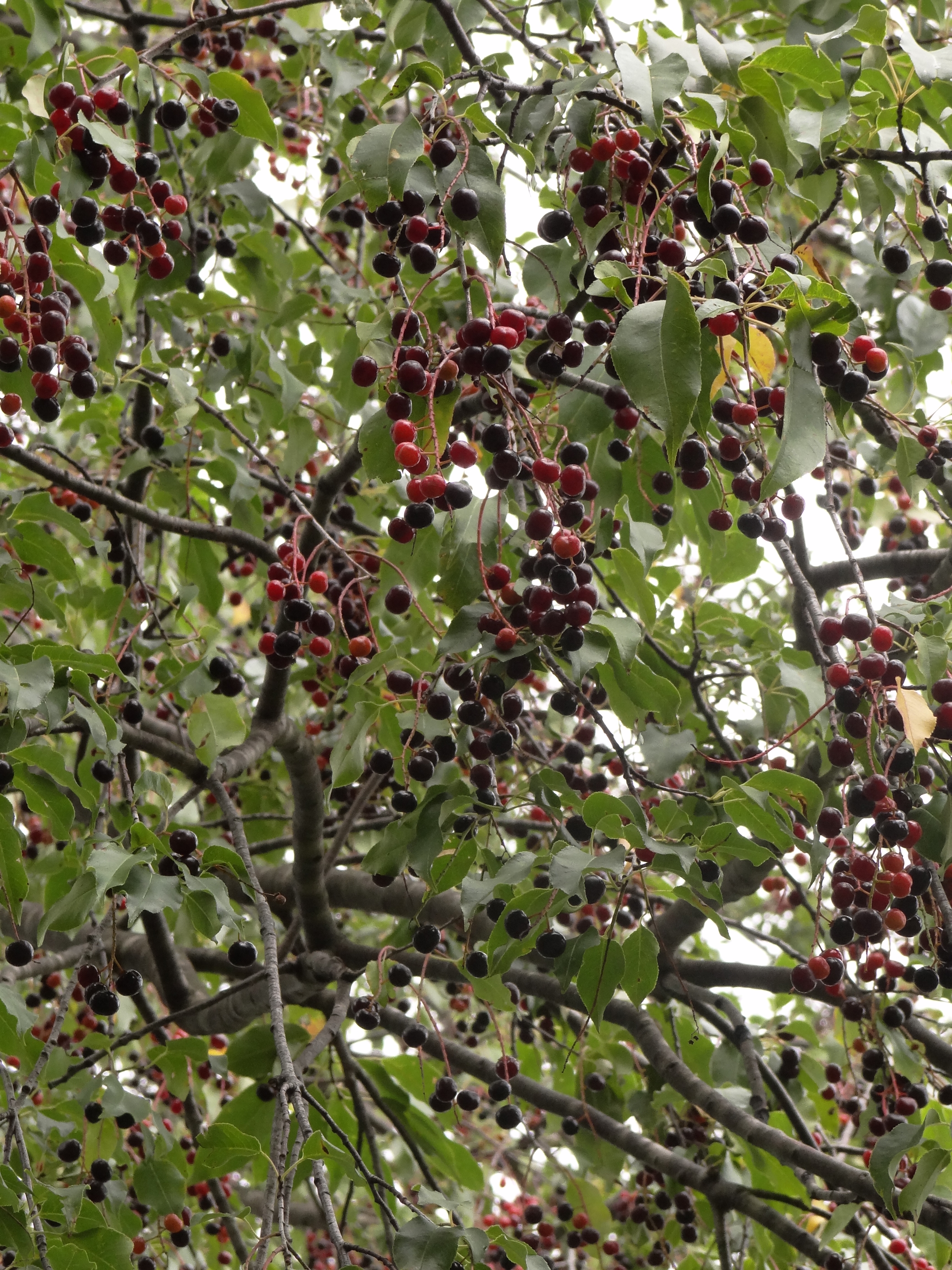
Wild Black Cherry Fruit Flavor
I made jam using ‘Sweeta’ Wild Black Cherry following a Sure-Gel recipe for cherry. There was no astringency, and the flavor was like a super concentrated form of black cherry. From this experience you could easily see its use for syrups and flavorings. It was an intense dark purple color almost black. I found it heavenly. The problem was collection or harvest. I had to cut one limb to gather the fruit for the jam. That is not sustainable obviously. Under cultivation this forest giant would create a challenge to keep the fruiting portion of the tree using shaking techniques to drop the fruit. It ripens over a long period of time and each raceme does not ripen all at once so there are unripe fruits next to ripe fruits so you have to let it go long in its ripening period. At the same time if you are investing in a fruiting tree, you want to harvest the logs at some point and fruit tree structure is normally not lumber quality structure. It is possible to create at least one saw log of eight feet prior to breaking up the crown into a more vase shaped open central leader system. This would make it possible to maintain the tree for fruiting without narrow crotch angles as well as having limbs which would be more productive for fruit. Treat it as a large sweet cherry tree in an orchard setting with a saw log attached. It is difficult to combine both wood and fruit together because they are usually the polar opposites of tree structure.
Wild Black Cherry Wood
It is interesting that a certain percentage of any hardwood tree species will produce strong apically dominant trees. It is just a natural tendency. From hackberry to coffee trees, you see these trees all the time and not just the fastigiate and pyramidal selections people find once in a while. For many years, I would drive by one wild black cherry tree down a slope near a major highway. This tree had a strong apical dominant leader with a strong pyramid shape with symmetrical branching. It was probably not the best location because highway living even 50 feet away is not far enough away to incur the wrath of safety-first tree removal, death by car or salt damage. For a brief time, a few nurseries offered an Appalachian form of black cherry. These were super vigorous and said to have very good apical dominance from seed with minimal culls. How did they find these? Some of the largest trees not messed with by human hands were found in this region where the tree can grow to magnificent heights completely knot free. These parent trees made excellent fast-growing trees easily growing 3-4 ft. tall in one year from seed. This type of selection is the nirvana of tree discoveries. What is not good is that no one had the foresight to make additional future forest seed orchards. If you build it, will someone come? I think it is the thought that maybe it is not necessary, and this is why the no show in seed orchards. Black cherry is all over. Why would you want to increase it even more? It really is an ignorant argument. At my farm I did begin a new selection process using new seedlings. One such tree is now 20 plus years old, and it too maintains its strong growth even while fruting. This tree flew by the hybrid pears I am growing for wood production and became a leave-it-and-see- tree at my farm.
Someday people will visit and wonder, “What is this?” Is it a pear, a cherry or something in-between? The answer contributes to this enigma of Prunus serotina. It looks like nothing we know. It creates a mystery within a mystery of its existence and life on planet earth. And you thought it was just a cherry tree with too many chromosomes.
Enjoy. Kenneth Asmus


 biologicalenrichment
You must be logged in to post a comment.