

Ground Floor and Going Up
I first found the concept of Two Story Agriculture in the best selling book Tree Crops: A Permanent Agriculture by J. Russell Smith. He was an economic geographer for Columbia University and had written extensively about land use and is considered the father of agroforestry. The title of his second chapter, “Tree Crops-The Way Out” with a sub heading of “Two Story Agriculture For Level Land” discusses the possibilities of using annual row crops with tree crops. It seemed to him that valuable real estate was being wasted and not used to its full potential. His ‘level land’ idea was to use trees as a type of vegetative buffer with different tree crops to harvest as well as to shade the soil and improve the crop yields below. As an example, you could also add the honeylocust or mulberry and then allow grazing of the animals in the pastures below supplied partially with additional feed supplements of the tree crops. My interpretation and implementation was to use woody and perennial plants in the understory in the attempt to create a highly diverse farm. The above image shows a slice of my plantings containing an example of two story agriculture. The tree on the far right is a shellbark-pecan hybrid followed by two types of late lilac species from China and then followed by a seed selection of northern pecan from Minnesota or Iowa. The tree in the background is a Quercus x bebbiana or Bebbs oak grown from seed discovered in Michigan. Each of these plants were grown from seedling in my nursery. It was very easy and inexpensive to do this. The crops in this area are pecan and hickory nuts and low tannin acorns. The results allow me to harvest seeds and make them available in a market of tree seeds. This in turn can make it possible for others to replicate my plantings in some individual interpretation of two story agriculture. Once in a while I will create something delicious from the crop plants. New seedling selections of chestnuts, apples, plums and cornelian cherries are coming on strong in this area most of which were planted by small mammals and birds. The largest trees tend to aid in this conversion of pasture to forest which essentially leads to a situation where it is not necessary to plant trees anymore. It is done for you.
Location, Location, Location
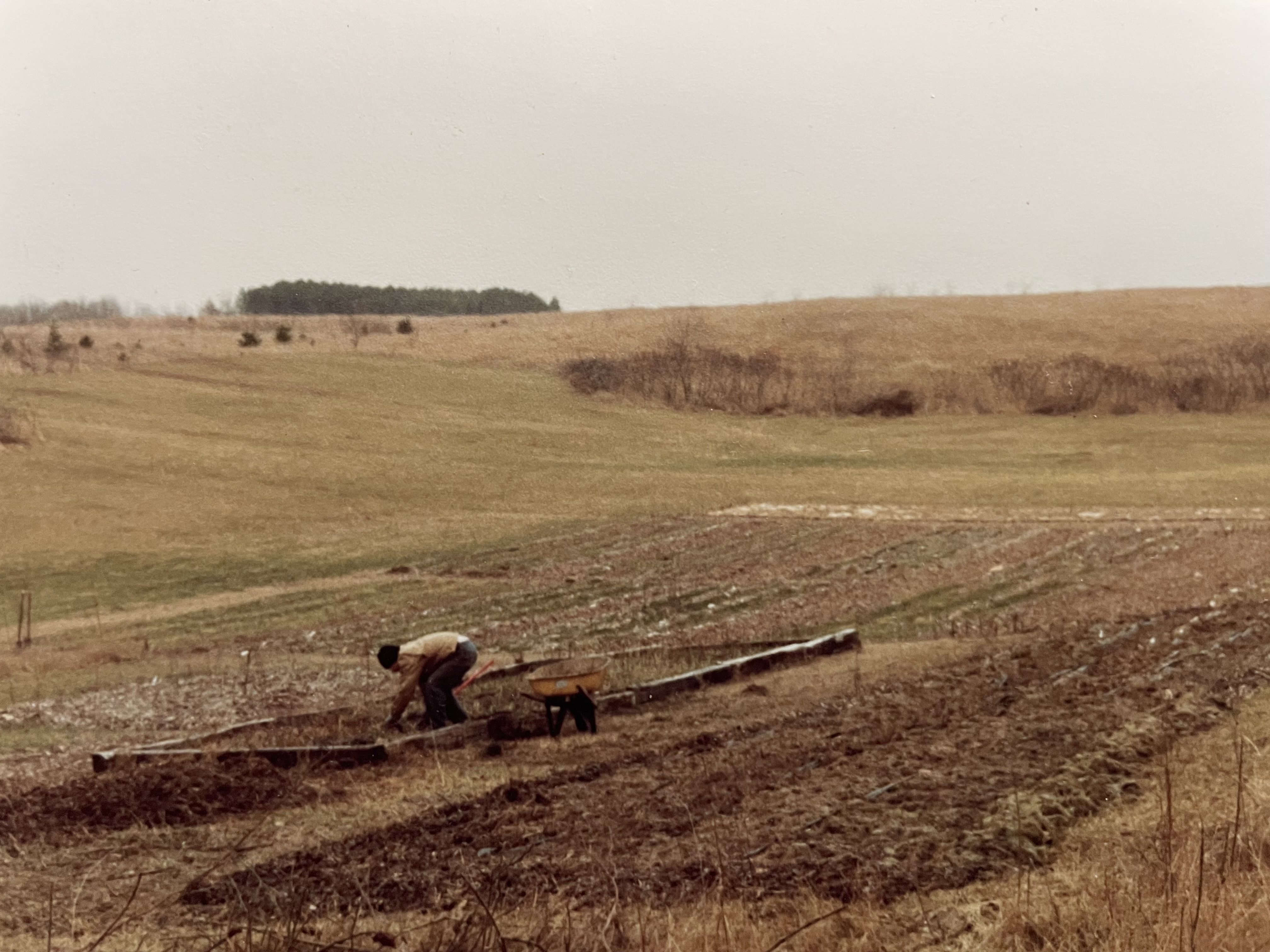
The image above is taken at the very top of the hill with the highest elevation in the area and was one of the most difficult places to establish trees due to the wind and drought in the summer. I lost a lot of trees when I first started planting there. With the advent of Tubex tree shelters along with changing my choices and timing, my success rate greatly increased. The fall planted oak and hickory began to make it through that critical first year. Just to the left of the picture is a steep hill facing due west. The prevailing winds are from the west and southwest. Particularly hit hard were many chestnuts and hazelnuts so I began using more oak and hickory within this area including shrubs like the lilac. As those species grew so did the self seeding of other trees including hybrid American chestnuts and shellbark hickory. It took 20 years for the whole system to begin to take shape. One area that is thick with dewberry, wild red raspberry and wild Himalayan blackberry became an ideal place to self seed as well as eliminating the pasture grasses.The turkey use this area to nest. Once the tap rooted trees grow deep into the subsoil, they grow very fast and are immune to drought even on this hill of sand. The two story root system reflects the canopy and is a mirror of what is below. Today it is very easy to grow other shrubs, small trees and perennial vegetables in this location due to the protection from the mature trees. Now it is time to make hay while the sun shines so the last few years I keep adding potato for groundcover. I am adding comfrey and self seeding yucca directly in the new plantings of plum and chinquapin chestnut.
The Power of the Lilac and Its Olive Family
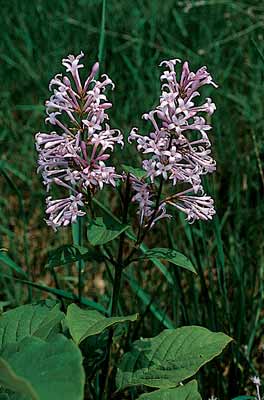
Conservation loves the lilac. It was the plant used extensively on the plains states as a wind buffer but it became popular due to the fragrance of the flowers and ease of cultivation. I started growing them from seed using commercially purchased seeds. There are many species of lilac and soon I created a collection of them at my farm meant for just this purpose. I focused on the seed production part of it as most of the Syringa vulgaris selections are done from cuttings. The common lilac was very prone to mildew so I looked for species that were immune to this weakening disease. I was particularly interested in the Himalayan, Preston, Late and the Korean species from seeds not clones. I scattered small plantings of them throughout my farm often in the worst locations where even the grass struggled. Typical of its olive family relationship, the Genus Syringa has very dense fibrous roots. This makes it very efficient at capturing water after a rain fall. If I had to do this again, I would of planted more lilac. The fragrance alone plays a role in calming down the human part of this equation of two story agriculture. I have been planting the northern olive look alike, Chionanthus virginicus, Fringe Tree and its Asian cousin, Chionanthus reticulatus hoping I could recreate the lilac effect plus make olives from the fruit. Chionanthus is much slower to establish in my ‘non-garden’ areas yet it has held up remarkably in those locations with reference to drought and competition from grasses. Three years ago a few started flowering after a fifteen year juvenile stage. No fruit so far therefore no experimental olives to experience. For now, I am going full lilac and plan to harvest seeds this coming fall. In the meantime, I continue to dream olives. Everyone has olive dreams, I am sure.
You could design and implement any number of combinations of two story agriculture with rich diversity. From ground up it could be wild tomatoes and white clover, plum and crabapple. It could be comfrey, wild peppers, neosinte-wild corn, plum and edible acorn oaks. This spring I am planting one now that uses comfrey and potato as groundcovers. The second story is cornelian cherry, Cornus mas. The third story is Chickasaw plum with shellbark hickory as an overstory. In this same area I am using a new form of Tree Lespedeza bicolor called Treefolia also known as shrub clover as a nitrogen fixer while direct seeding mixed species of yucca to help loosen the soil which will allow better water percolation. Even by acccidental or intentional human introduced associations, plants integrate and become the community of all inclusive possibilities in a two story system. My nearby Paulownia tomentosa selections for wood are slowly becoming engulfed with the Chickasaw plum colony. The Russian and Kansas selections of wild bergamont make up a portion of the groundcover as a flavorable tea plant. It is a guild with infinite variations where all tomatoes love carrots scenario. There are no weeds.
Tree Crops-The Way Out and Two Story Agriculture for Level Land. A few words is all I remembered. That was enough to help me fulfill my life with trees.
Enjoy. Kenneth Asmus


 biologicalenrichment
You must be logged in to post a comment.