Many species of woody plants survive only because people move them out to new locations where they would never be found ala naturelle. They may provide a source of seeds which can be used to create additional selections. Like the northern short season pecans at my farm, they can create whole populations instantaneously. Humans are natural vectors and bring huge benefits in the movement of plants. Moving and cultivating plants helps the environment prevent ‘vegetative’ stagnation through their symmetry breaking actions. The people who interact with the environment daily, like farming, benefit immensely from this activity. The origin story of alfalfa, the Grimm alfalfa was done by this method. Today it is the third largest crop in the United States. Normally there is no commercial value. Instead it is someone in love with the plant and wants to bestow to the land a plant never seen before. Over time the person who did the planting may have long ago moved away and the source remains a mystery. No one sees it for years until by sheer luck with someone with horticultural experience finds it. Such is the case for Southern Magnolia. For me, this was the one that got away. Here is how that went down on my terra firma.
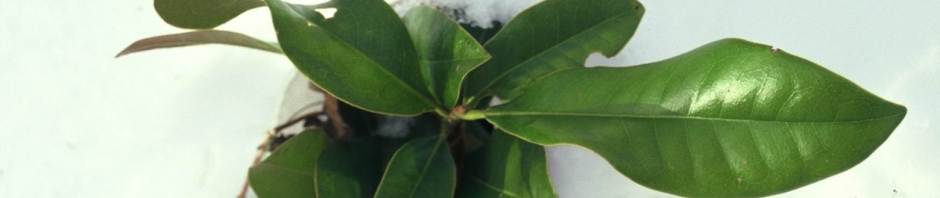
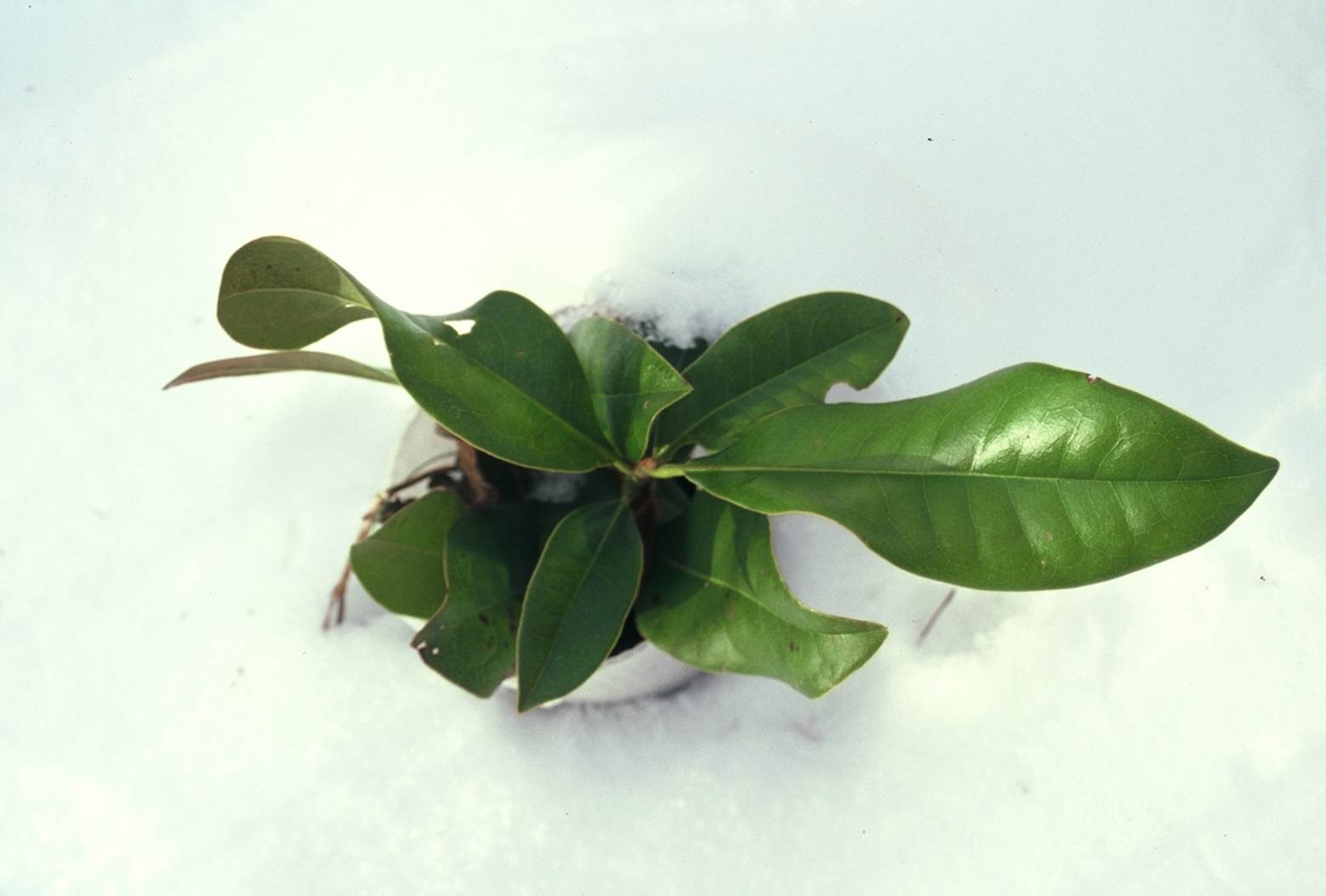
The image above represents an individual plant in my little plantings of the coldest hardy Magnolia grandiflora I could find. I grew all of them from seed from the most extreme outliers of cold hardy individual plants that came to existence mostly through human intervention. I planted the seedlings outside as one- and two-year plants in these small plastic collars to protect against the elements. I mulched around each tree. I treated those trees like they were given to me directly from heaven. At some point I had over 40 plants outside growing in various stages. They were planted on a north facing slope somewhat protected by the oaks, pears and hickories I planted a decade earlier. The goal was to obtain a fully hardy evergreen tree to 80 feet tall. Why not? The species grows like this already. It was not like I was going to have to reinvent the wheel. Nature had already created it. The difference was I was growing seedlings and wanted to recreate that in the state of Michigan. As time went on, my little trees failed one after another until finally only one was left after a decade of trying. This one tree was impressive and grew to 3 ft. tall. But it too suffered huge damage in many winters. The seed sources go by names like “Minus 22F” and “Indiana-Wants-Me” and others. It turned out I was not alone. People were into finding this southern species because it is such a classic tree in North America. Everyone is on board. Even today you see these new cold hardy varieties meant to fight off the winter winds. The bottom line is this: no one I know grows them in cold areas like Michigan. It’s more like the Tennessee of winters. This is not the same. Go outside in your pajamas when it’s windy in January. There’s a difference. You might be able to get the mail but you’re not shoveling snow. The plants know this. People not so much so it’s a sort of genetic roulette.
I believe I approached my plant project with too much project like mentality. It was a long process. The seeds were very difficult to find let in good condition from collectors. Magnolia seeds once dried are not possible to resuscitate by adding water. The embryo degrades quickly when dried. They were erratic to germinate compared to other Magnolia seeds. If the fleshy seed cover is not removed soon after ripening, then the seed rots easily. You must do several cleanings to get them spotless. The seeds require a moist 90 day refrigeration between 34F and 38F temperature regime. The first-year seedlings are small so I kept them in my polyhouses for two years before moving them out to the great outdoors. The polyhouses did create a Zone 7 Tennessee winter with minimal fluctuations and no wind. Any broadleaf evergreen benefits from this cozy treatment.
I began wondering if it was the consciousness of the individual who loved the tree that created its hardiness. The grower creates a bond of friendship and to a certain extent it is an expression of happiness to see each other every day. The tree then responds to its caretaker no matter where that person lives. Maybe someone lived in the southern U.S. where the tree grew in great abundance, and they brought it with them. I think there is some truth to this which then entertains the idea of plant and human connections.
Recently I was contacted with a lead on a giant Southern Magnolia tree rich in cones not too far from me. We are currently making plans to obtain cones and cuttings. The collector also grows plants and he remembers the loss as the one that failed. He cannot forget it. For both of us, it is the memory of a beautiful plant that has a great potential in a northern world that increases the motivation of finding a means to make this a reality. Finding a novel seed source is the start.
ON SEED SOURCES:
It is generally thought that a plant growing in an area for a long period of time is adapted to the climate and conditions around which it resides. What is missing in this understanding of adaptability is what I call the ‘loner’ plants. ‘Loners’ are individuals that defy the odds of survival somehow and don’t fit into the nice smooth lines of the range maps in the botanical literature. This is because the smooth lines are actually dotted, and the range is porous like a membrane which is always expanding. The dots can extend in all directions sometimes hundreds of miles from what is thought of as the normal population. Bur oak is a good example. It is found far out west to the point people often view it as human induced populations. There are palm trees in the United States like this because coyotes and migrating birds consume the fruit and can travel long distances creating disjointed populations. At my farm I have several Georgia seed source baldcypress and Alabama hybrid oaks completely adapted to Michigan with zero winter damage. Here I took the ‘quasi-loner’ plants from a population that had problems surviving and selected the most vigorous and hardy plants from the population. Every once in a great while, there are ‘loner’ plants that are super isolated. These may or may not offer a population of adapted plants. They might be that unique that the population of seedlings they produce is not adapted in the surrounding environment. There is no way to tell unless you actually grow the plants and test them. ‘Loners’ can create new populations, and these can then expand the plant into new horticultural and agricultural possibilities. It appears with the southern magnolia; hardiness is not just a one plant solution. To create a solution, find several hardy plants and grow them in windy unprotected and Zone 5 locations. Now you have a place to start should you collect other ‘loners’ turning them into a community of likely individuals to create the population you are looking for using all seed as they mix together.
That’s right. Your loners are no longer lonely.
Enjoy. Kenneth Asmus


 biologicalenrichment
You must be logged in to post a comment.