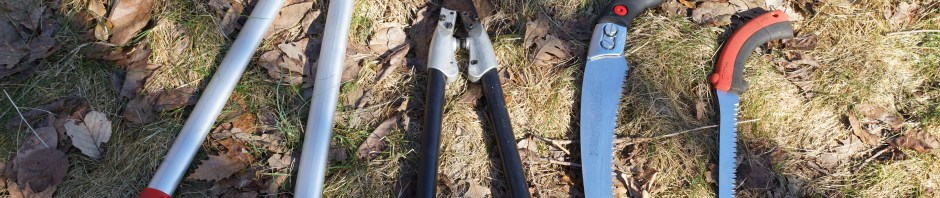
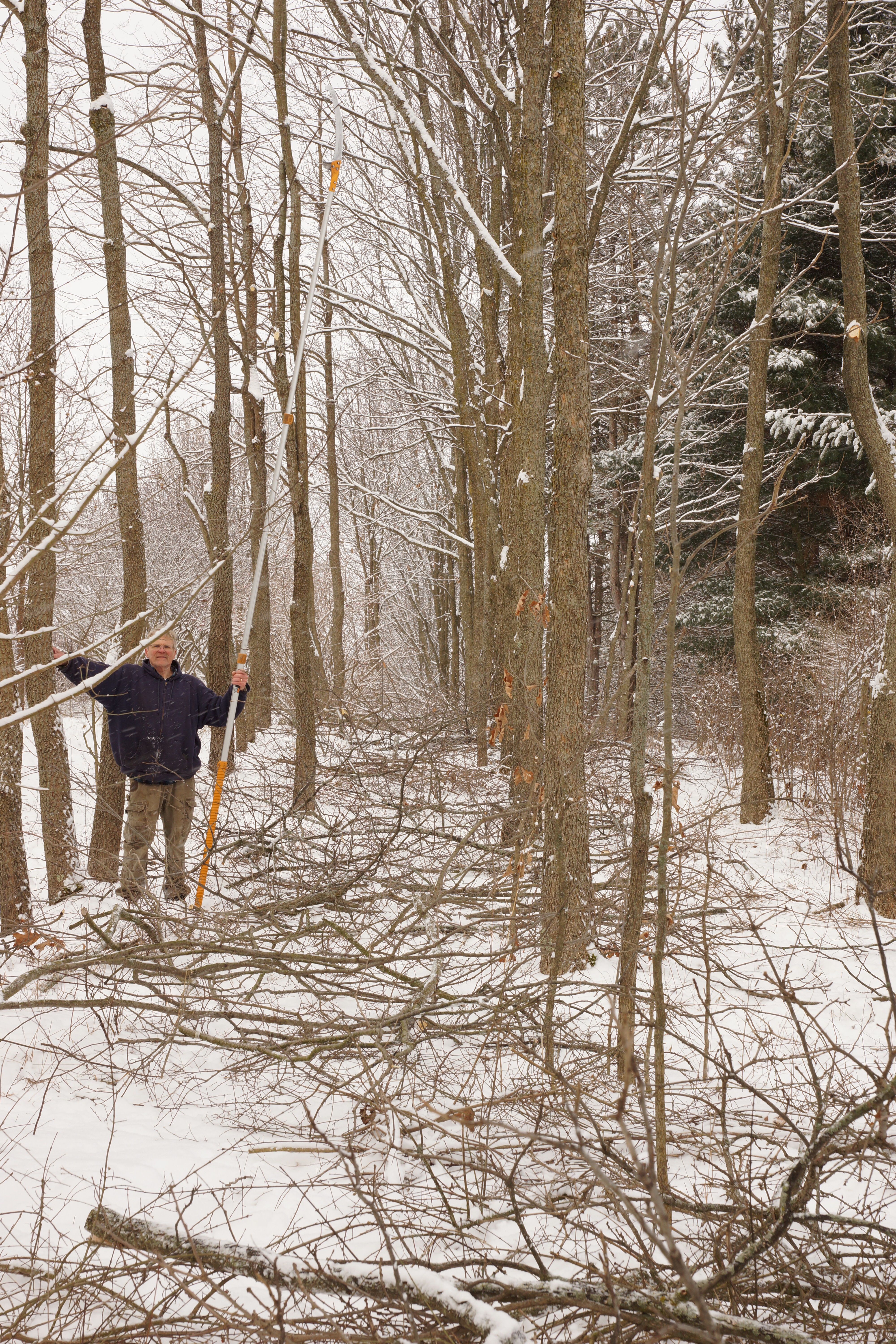
In the winter, I do a lot of pruning. There are no yellow jackets to avoid. The plants are dormant which is ideal and it is much easier to maneuver and identify shrubs and trees that seed in under my planted trees. I keep them and limb them upwards. It is surprising that a number of apples fruit fairly well in the shade of the pecans. Here I am leaning on a row of American persimmon trees with my Silky pole pruner next to two rows of northern pecans on the right. Both require removal of the lower limbs as they fade due to lack of light enhanced by the density of the planting I did. At the time, I thought both of those species were not going to be that successful in southwestern Michigan because it is too cloudy and cool here to fruit and mature properly. I was wrong. As a result, I began pruning them to allow greater light to penetrate the floor and allow the crowns to gain greater volume and height. That was a good idea because now I have apples, pears and young seedlings of pecans and persimmons under the canopy replenishing itself into the distant future. A nearby white pine has also seeded well and I have used the seedlings as a visual road block at my home. This type of planting creates the ideal seed bed as grass has faded. This was a thick grass field here dominated by quack grass which is now gone entirely due to the increased shading over time. The sod is now a thing of the past. Besides the highly benefical amur honeysuckle and autumn olive plants, the seed bed also is transforming the understory benefiting the trees and future of my mini-forest. When I cut these to the ground, they add organic matter to the soil. You do not need herbicide or burning. Those only create problems. I have spotted some medlars, American holly and American cranberry-bush here. While I create mulch and fertilizer for the trees, the soil can only improve. The branches you see on the ground above take 4 years to break down. Several species of borers live in them spewing out sawdust. They are the mini-chippers doing what would take me many long hours behind a flail mower or wood chipper. Here you want the various stages of decay feeding the fungus in the soil along with all the micro-fauna. I like taking a peak into the this microuniverse from time to time. There is a lot of things going on so its fun to look under a larger piece of wood. Sometimes you’ll find the larvae of fireflies which also have bio-luminensce. They hide embedded under the bark and you can sometimes find them even in the dead of winter if you look hard enough.
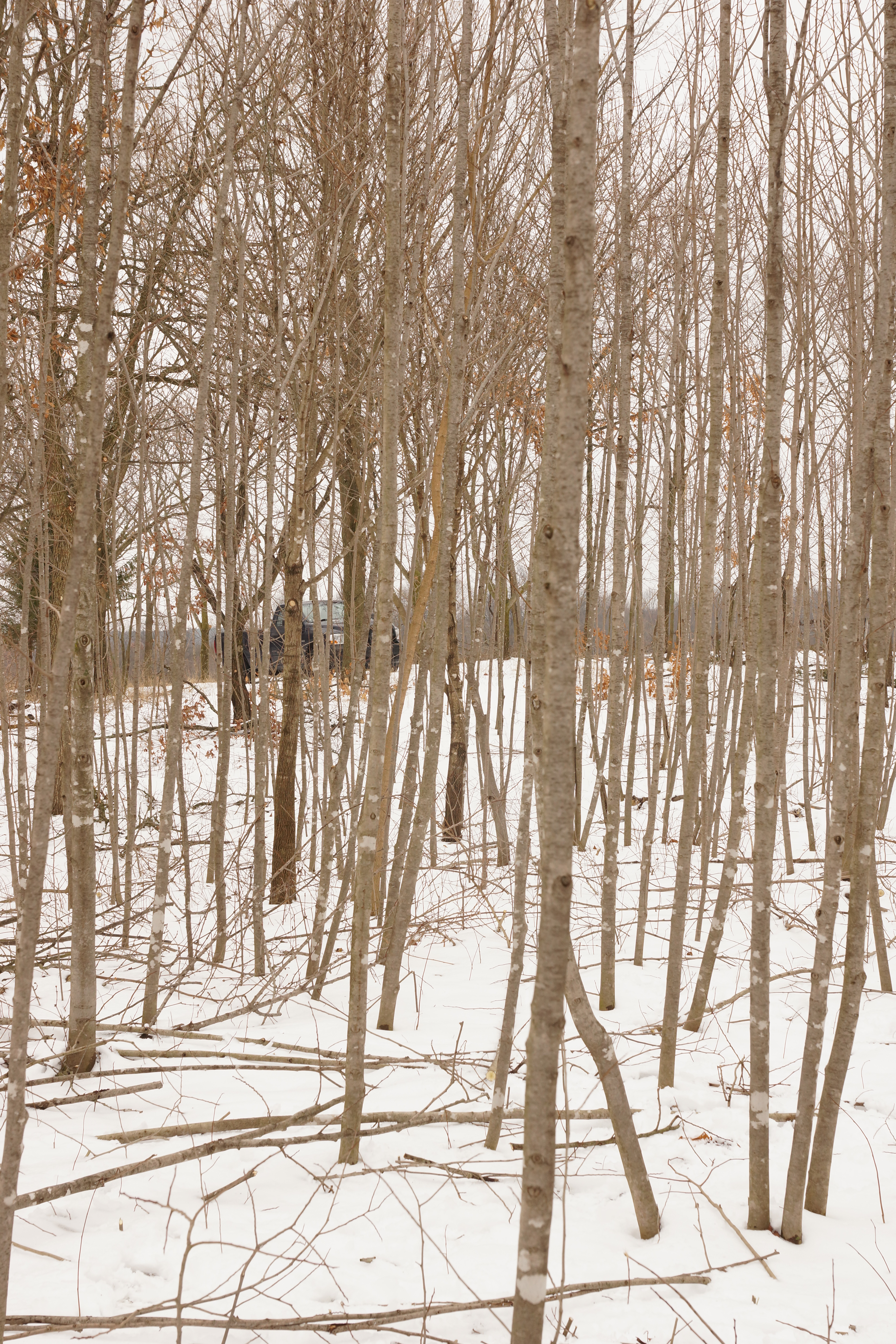
Pawpaw colonies have a life of their own forever expanding and taking over vast areas. This tendency creates a great density of shade within the planting. There is hardly any recruitment of any type of seedling tree or shrub. A few multiflora roses struggle to gain a toe hold. The wild black raspberries fade and the thick colonies of golden rod disappeared entirely. The quackgrass died years ago after the canopy closed. The pawpaw marches on shading and creating the perfect habitat for itself free of pretty much any competition. I did plant several Chinese ash species here and they have done very well and are completely immune to the ash borer. You will see possums in here along with red squirrels eating the ash seeds as they mature. This particular planting had trees spaced at 20 ft. apart in three long rows done in 1988. This was the year of severe drought where every county in Michigan was considered a disaster area. The trees survived and flourished once I stopped using Round-Up to kill the grasses around them and then mulched them with rotted wood chips. Pruning in this planting involves thinning to allow greater lateral branching while at the same time not removing everything. Pawpaw trees live for 30 years or so before the main trunk dies. It is replaced by the ‘suckers’ or new trees as they stoloniferously spread across the landscape. This creates the effect of side branching on the trees which then increases fruiting. You can find that the colony does this for you as well. You can push a tree over as it snaps near its rotted base. This type of thinning is done every three years or so. In one pawpaw and black walnut planting I am trying an understory or black and green gooseberry. It appears the shrubs can tolerate the shade but few fruit seem to form but the bushes look very healthy. This would be a level three crop in the shade of two other food plants. I am wondering if I could grow other vegetatables or medicinal plants like ginseng in here too. It is like a super highway in the pawpaw grove and people notice when I take them there it has a comforting effect.
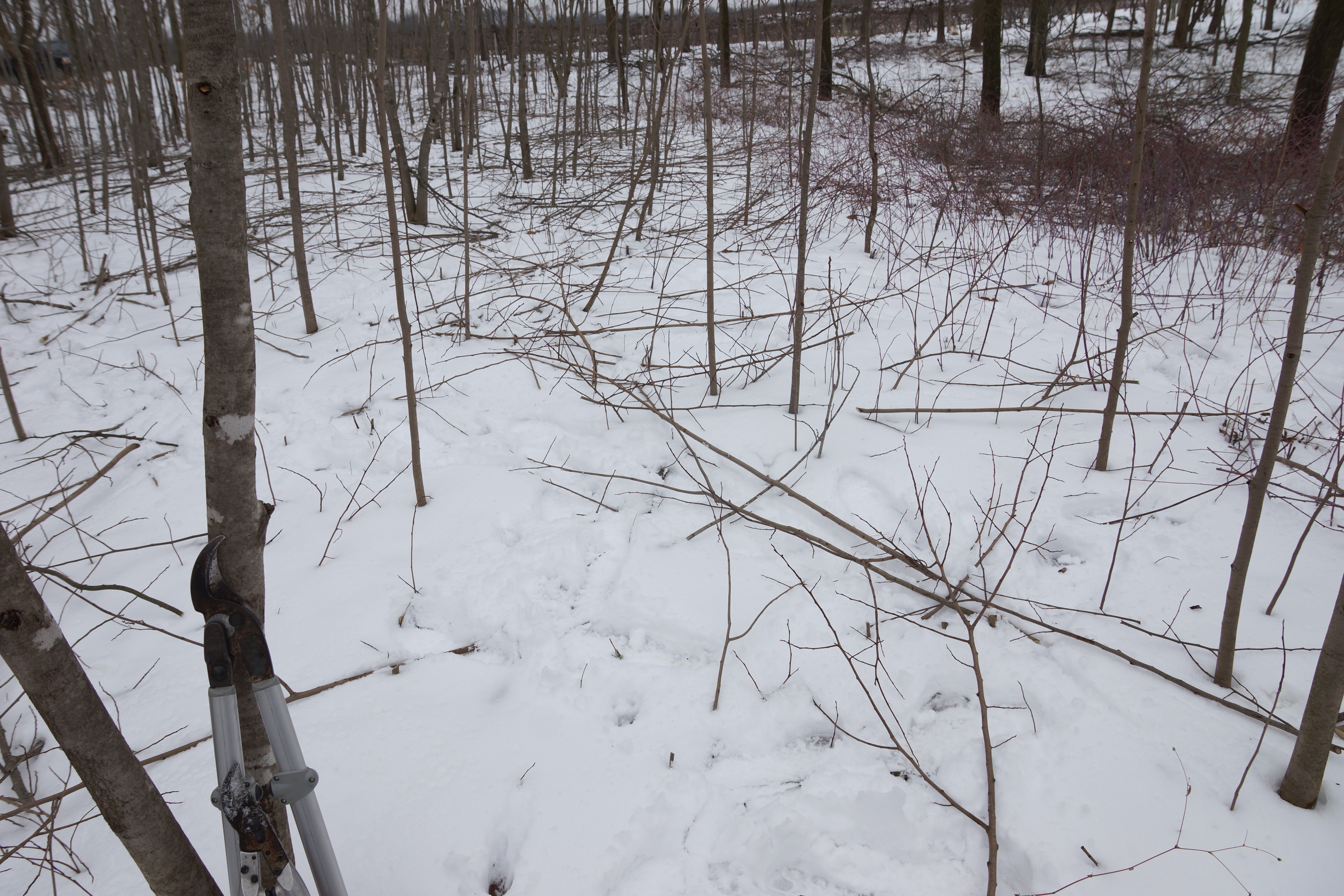
The tree on the left on this image with the pruners leaned up is one of the original trees planted in 1988. It is still very healthy. In the upper right is a colony of raspberries. Those are slowly fading out. When I have dug into the soil here, I noticed the root systems are dense and over lap like a giant matrix of stolons which explains why on the hillside there is no erosion. This is the stoloniferous roots of great magnitude produced by the pawpaw. If you have a grafted variety, this is not possible to recreate. So seedling orchards could easily play a role in fruit production on a commercial level in places where orchards are not practical. This system is self sustainable with a little pruning and some tender loving care of a happy farmer. It’s a vigorous life.
Enjoy. Kenneth Asmus


 biologicalenrichment
You must be logged in to post a comment.